

Key Takeaways: Comparing Botox and Aesthetic Medicine Training for Doctors in Quebec
- For many Quebec physicians who are adding aesthetic medicine to their practice, the first step is not choosing a commercial course. The CMQ instructs physicians to contact its Direction du développement professionnel et de la remédiation (DDPR) before undertaking other steps for procedures they want to add.
- A commercial Botox course, filler course, medical aesthetics program, continuing professional development activity, or certificate does not automatically become the physician’s CMQ-approved training stage.
- The CMQ’s public guidance describes theoretical preparation and a practical training stage that must be accepted before it is completed and supervised by a maître de stage mandated by the CMQ when the stage is required.
- The CMQ’s 2020 guidance describes a minimum practical stage of four days that includes treatment and follow-up of at least five patients across different anatomical areas and with different products or devices.
- When comparing commercial training, look beyond the certificate. Evaluate Quebec-specific regulatory education, curriculum breadth, supervised live-model learning, instructor experience, class size, complication management, and whether the provider clearly distinguishes course completion from the CMQ process.
Botox courses for doctors, Botox training for physicians, Botox and filler training, medical aesthetics courses, and aesthetic medicine training are common search terms used by physicians exploring this field. In Quebec, those terms describe commercial education. They do not replace the physician-specific process established by the Collège des médecins du Québec. This article uses botulinum toxin A (aka BoNT or botox) on first clinical reference, then uses botulinum toxin, toxin, or neuromodulator where appropriate.
Comparison disclosure and evidence standard
This article is published by AMEQ Academy. It uses current public CMQ material, AMEQ-confirmed information, and publicly accessible provider pages reviewed for this comparison. A positive status is used only where a point is directly supported by the material reviewed. Not publicly confirmed means the point was not reliably established from the public material reviewed. It does not prove that a provider lacks the feature. A provider’s statement that a course is compliant, accredited, certified, or aligned with a regulator is treated as the provider’s own statement, not as independent CMQ approval. Physicians should confirm their own requirements directly with the CMQ and their professional liability insurer.

What the CMQ Requires Before a Physician Begins Aesthetic Medicine in Quebec
Direct answer
The CMQ states that physicians who are adding aesthetic medicine procedures to their practice should first submit the applicable request to the DDPR so the College can determine the relevant professional-development pathway. For physicians who require a formal training stage, the theoretical and practical activities are integrated into a stage accepted in advance by the CMQ and supervised by a CMQ-mandated maître de stage.
1. Contact the DDPR Before Paying for a Commercial Course
The most important practical point for a Quebec physician is sequencing. The CMQ’s public guidance says that, before any other step, the physician should complete the Demande d’ajout, de changement de domaine ou de retour à l’exercice for each aesthetic medicine procedure they want to add and submit it to the College so the appropriate activity can be organized.
That is why a physician should not rely on a training provider’s statement that a course is “CMQ compliant,” “recognized,” “accredited,” or sufficient for a Quebec pathway. Before committing financially, the physician should contact the DDPR, describe the intended change in practice, and request clear written direction on the applicable pathway, learning objectives, stage requirements, and supervision.
CMQ first, commercial course second. Continuing education credits, certificates of completion, provider accreditation, and commercial board certifications can have educational value, but they are not interchangeable with the CMQ’s physician-specific DDPR decision.
Official CMQ resource: Update to the CMQ aesthetic medicine practice guide.
2. The CMQ Direction du développement professionnel et de la remédiation (DDPR) Notification and Assessment
The CMQ’s 2023 article states that, since August 2020, physicians other than those initially trained in aesthetic medicine who want to begin this type of practice must inform the DDPR because the change to their practice may require completion of a training stage. The CMQ identifies plastic surgeons, dermatologists, and otorhinolaryngologists among the physicians trained initially in relevant aesthetic medicine activities. The CMQ also directs physicians who were previously trained but have not practised aesthetic medicine for three years or more to contact the DDPR before restarting.
The resulting pathway is physician-specific. The DDPR can determine what additional training or stage is required based on the physician’s existing training, practice history, and the procedures the physician plans to add.
3. The Formal Training Stage
When a formal stage is required, the CMQ describes theoretical and practical education integrated into a professional-development stage that must be accepted by the College before it is carried out. The activities must be supervised by a maître de stage mandated by the CMQ.
The CMQ’s 2020 update states that the practical stage has a minimum duration of four days and must include treatment and follow-up of at least five patients, involving different anatomical regions and different products or devices. Follow-up should take place two weeks after injection. The stage is not created retroactively simply because a physician has already completed a commercial course.

4. Theoretical Education Is Broader Than Injectables Alone
A physician may search for a Botox course or Botox and filler training because injectables are the immediate clinical interest. The CMQ framework is broader. The CMQ framework reviewed for this article identifies theoretical objectives that include facial anatomy, skin physiology and aging, cutaneous pathology, injectable products, laser and energy-based modalities, chemical exfoliation and other relevant aesthetic treatments, indications and contraindications, adverse effects, follow-up, complication management, and Quebec-specific professional obligations.
That distinction matters. A physician who intends to offer only neuromodulators or hyaluronic acid dermal filler may still need theoretical education broad enough to assess whether another modality is more appropriate and to recognize when referral is required.
5. Ongoing Practice Obligations Continue After Training
The CMQ’s current public material emphasizes responsibilities that extend beyond course completion. Its 2023 guidance requires clinics to organize post-injection access to a physician competent in aesthetic medicine within 15 minutes to manage a complication and administer urgent treatment where appropriate. Current CMQ record-retention guidance also states that clinical records kept outside an institution are generally retained for at least 10 years from the last entry, subject to transitional rules for paper records that existed on July 11, 2024.
The CMQ also maintains specific deontological resources addressing medico-aesthetic fees, professional independence, incentives of any kind, advertising, and professional titles. Examples include restrictions relevant to offering free treatment in exchange for a patient’s agreement to have results published on social media, or online promotions such as raffles for free treatment tied to engagement with a post. Physicians must also respect the CMQ’s rules governing commercial brand references and the sale of products in settings where they perform medical injections. A physician training program serving Quebec should therefore teach the practice environment, not only injection technique.
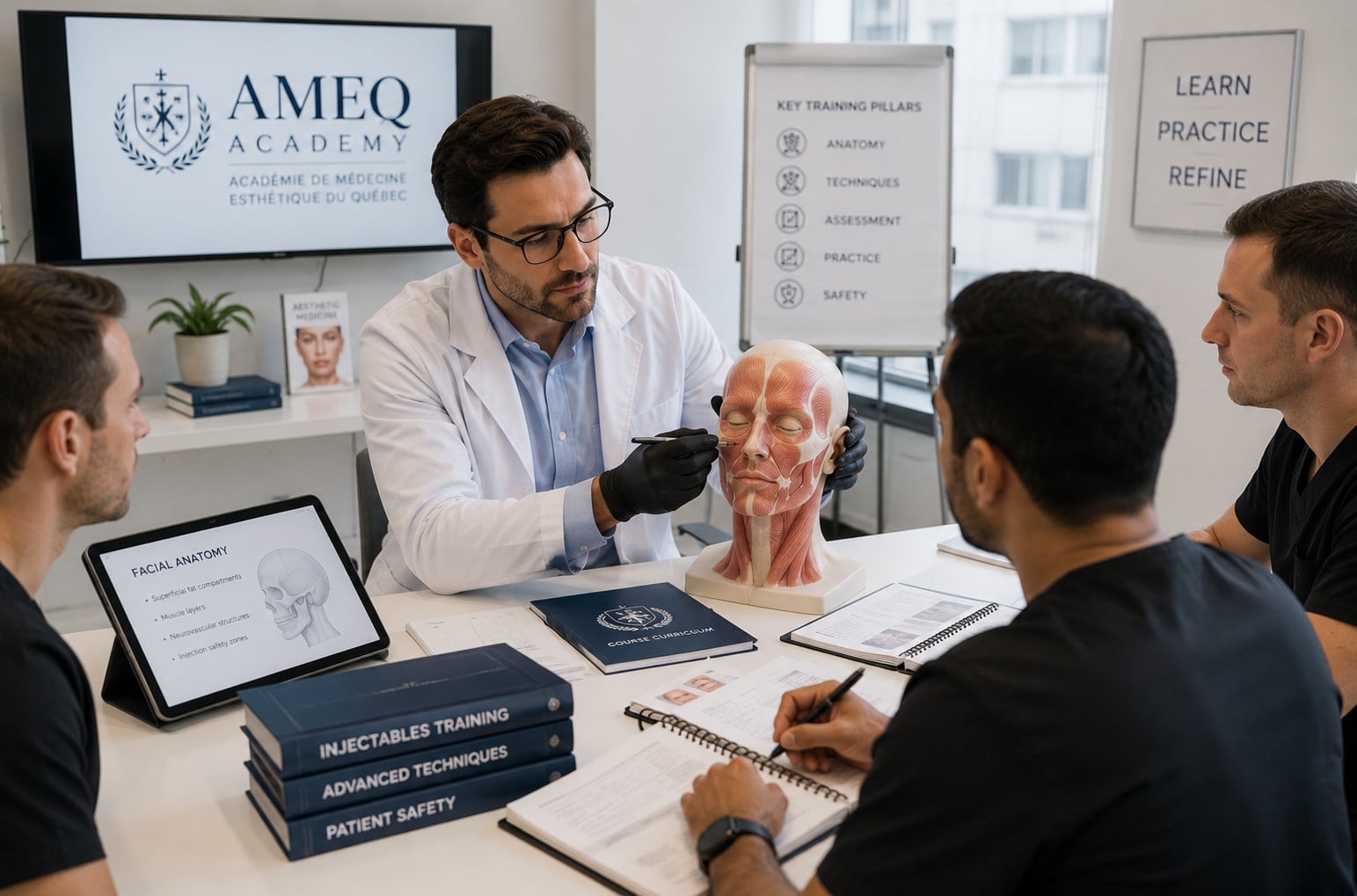
What Commercial Training Can and Cannot Provide
Commercial physician training can provide valuable theoretical education, structured teaching, supervised practical exposure, anatomy review, complication-management education, and a framework for entering a new area of practice. It can also help a physician identify knowledge gaps before engaging with the CMQ’s formal process.
What a commercial provider cannot do unilaterally is determine that its certificate replaces the physician’s DDPR notification, appoint the CMQ’s mandated supervisor for every physician, retroactively convert its course into an accepted CMQ stage, or guarantee that a physician is authorized to begin practising a specific procedure in Quebec.
Does a commercial Botox certificate authorize a Quebec doctor to start practising aesthetic medicine?
No commercial certificate should be treated as automatic authorization. The physician’s obligations depend on the CMQ’s assessment of the change in practice. The safest sequence is to obtain CMQ direction first, then select education that fits the physician-specific pathway.
How to Evaluate Botox and Aesthetic Medicine Courses for Doctors
Once the physician understands the CMQ pathway, the commercial training decision becomes much easier to evaluate. The strongest comparison questions are not “Which certificate sounds most impressive?” or “Which provider says it is approved?” They are questions about educational depth, evidence, supervision, and Quebec-specific context.
Does the program explain the CMQ DDPR process?
A Quebec-focused physician program should explain that the physician-specific CMQ process comes before assuming a commercial course is sufficient. If the public course page focuses only on certification and technique, the physician should ask the provider directly how the program relates to the DDPR process and request the answer in writing.
Does the theory cover aesthetic medicine, not only two injectable products?
Botulinum toxin A and hyaluronic acid dermal filler are important topics, but the CMQ’s theoretical expectations extend beyond them. The physician should ask whether the curriculum addresses dermatology foundations, energy-based modalities, skin assessment, broader treatment selection, complication management, professional duties, and referral decisions.
Does introductory education include both neuromodulator and filler principles?
Because “Botox and filler training” is one of the most common commercial search intents, this comparison records whether the current public introductory curriculum expressly includes both. This is a curriculum-breadth criterion only. It is not a CMQ approval criterion.
Is practical learning supervised and performed with live patients or models?
Hands-on clinical education can help a physician translate anatomy and pharmacology into assessment, planning, technique, and complication awareness. The quantity of exposure is not the only factor. Small-group structure, direct instructor feedback, case diversity, and the opportunity to discuss clinical reasoning all matter.
Who teaches the course?
For physicians, instructor identity matters. A physician educator who actively practises aesthetic medicine can connect technical instruction with diagnosis, treatment selection, medical decision-making, complication management, and professional responsibility. A multidisciplinary faculty can also be useful, but the physician should understand who is responsible for clinical teaching and supervision.
Does the provider distinguish continuing education credit from CMQ stage approval?
Royal College Section 1 credits, Mainpro+ credits, university CPD, certificates, or other continuing education credentials can be legitimate educational signals. They do not independently establish that the physician has completed the CMQ’s required change-of-practice process.
Does the program teach Quebec-specific professional obligations?
Look for explicit education on DDPR notification, stage structure, the 15-minute availability requirement, complication pathways, patient evaluation and treatment planning, record retention, professional independence, fees, incentives of any kind, advertising, and collaborative practice.

The Market: Physician Aesthetic Medicine Training Providers
The providers below offer physician-facing aesthetic medicine education or related continuing education. This section compares what can be verified publicly. It is not a list of CMQ-mandated maîtres de stage and it should not be interpreted as a list of training providers approved by the CMQ for a physician’s individual stage.
AMEQ Academy
AMEQ Academy offers physician-led aesthetic medicine education in Quebec. The physician program described in the reviewed AMEQ source combines online theoretical education with supervised in-person practical learning and explicitly places commercial training within, rather than above, the physician’s CMQ obligations.
- Physician-led by Dr. Angelina Guzzo, BSc, PhD, MDCM, FRCPC, a specialist in anesthesiology with active aesthetic medicine teaching experience and one of the CMQ-accepted maîtres de stage for medical injectables.
- Quebec training context with Montreal and Saint-Sauveur locations.
- Public positioning for this comparison explicitly tells physicians that commercial training does not replace the DDPR process or a CMQ-required stage.
- Reviewed AMEQ curriculum includes neuromodulator and filler principles, broader aesthetic medicine theory, complication management, and Quebec professional responsibilities.
- Supervised practical learning is delivered in a small-group format designed to support direct instructor feedback and clinical discussion.
- The physician must still obtain CMQ direction for their own change of practice. AMEQ cannot guarantee that a particular commercial course will be accepted as the physician’s formal stage.
- Course dates, availability, pricing, and the physician-specific stage plan must be confirmed separately.
AMEQ source: Physician aesthetic medicine training at AMEQ Academy. Physician-specific CMQ direction remains authoritative.
Premier Injectors
Premier Injectors is a Montreal academy with physician and nursing faculty. Its current combined Basic and Advanced course package for doctors and nurses publicly describes more than 40 hours of hybrid instruction and four full days of supervised clinical injection practice on real patients.
- Montreal delivery is explicit.
- The combined package publicly includes both neuromodulators and dermal fillers.
- Four full days of supervised clinical injection practice are stated for the combined package.
- The provider describes Mainpro+ credit eligibility for qualifying physicians.
- The statement that the program was developed in line with CMQ standards is a provider statement, not independent proof of the physician’s CMQ stage approval.
- The public combined-package page reviewed does not clearly explain DDPR notification, CMQ appointment of the maître de stage, the stage report, or the distinction between a commercial course and a CMQ-approved physician-specific stage.
- Premier’s public training material reviewed does not clearly identify the physician responsible for the training. AMEQ’s review of the current CMQ list of accepted maîtres de stage and associated training locations did not identify Premier Injectors’ training address among the accepted locations for an activité de perfectionnement in aesthetic medicine.
- The combined package clearly covers toxin and filler principles; the structure of the stand alone introductory Basic course should be separately verified if that is the course being considered.
- A participant-level total of 20+ supervised live-model learning opportunities was not publicly confirmed from the material reviewed.
Competitor source: Premier Injectors Basic and Advanced package.
CBAM – Canadian Board of Aesthetic Medicine
CBAM operates a Montreal training centre and markets a broad aesthetic medicine pathway to physicians and other healthcare professionals. Its current Montreal material includes a basic injectables course covering neurotoxin and filler skills, online theory, and in-person hands-on clinical education.
- Current public material confirms Montreal delivery.
- The 2-Day Basic Injectables course publicly includes botulinum toxin and dermal filler content plus hands-on practice on live models.
- CBAM is chaired by Dr. Reza Akef, a physician with extensive cosmetic medicine teaching and practice experience.
- Current public materials describe recognized continuing education credits for selected activities.
- The public Montreal and basic-course pages reviewed do not clearly explain the physician-specific CMQ DDPR notification sequence.
- A commercial “board certification” or CBAM certificate is not the same as a CMQ-mandated stage or CMQ authorization to add a domain of practice.
- AMEQ’s August 2026 review of the current CMQ supervisor list indicates that Dr. Reza Akef is not listed among the accepted supervisors for an activité de perfectionnement in aesthetic medicine.
- Quebec-specific content such as the 15-minute rule, the current 10-year record-retention framework, and the CMQ stage-report process was not reliably established from the public course pages reviewed.
- A participant-level total of 20+ supervised live-model learning opportunities was not publicly confirmed from the material reviewed.
Competitor source: CBAM Montreal programs and CBAM Basic Injectables course.
IMEM – Institut de Médecine Esthétique de Montréal
IMEM was founded by Dr. Geneviève Blackburn and offers education to healthcare professionals in neuromodulator and filler techniques. Public material confirms a Montreal-based physician-led aesthetic medicine context.
- Physician-led by Dr. Geneviève Blackburn, whose public material documents extensive medical-aesthetic practice.
- Montreal-based training context.
- Public descriptions confirm education in neuromodulator and filler techniques.
- Dr. Geneviève Blackburn is on the CMQ list of maîtres de stage to provide an activité de perfectionnement in aesthetic medicine.
- IMEM offers two separate courses for physicians. One is a 2-day course in which the physician must bring two of their own models and performs the injections. According to information confirmed directly by AMEQ, this is IMEM’s most popular physician course, but it does not meet the CMQ standards for the required training pathway.
- IMEM also offers a course that meets the CMQ requirements, involving 4 days, 5 models treated in different anatomical regions, and information about other treatment modalities, including laser.
- Before registering, physicians should make sure they are choosing the IMEM course that meets the CMQ standards rather than assuming that every physician course offered by an accepted maître de stage automatically satisfies the CMQ requirements.
- The reviewed 2-day IMEM offering uses two participant-supplied models, so that course does not meet the 20+ supervised live-model learning opportunities criterion.
Competitor source: IMEM information from Dr. Geneviève Blackburn.
Mediluxe – Physicians
Mediluxe markets injectable training for licensed Quebec physicians in Montreal. Its current physician page states that the program is designed around CMQ requirements and includes facial anatomy, neuromodulators, fillers, professional responsibilities, complication management, and hands-on training with real patients.
- Quebec physician audience and Montreal delivery are explicit.
- Public materials confirm hands-on work with real patients.
- Public curriculum includes facial anatomy, neuromodulators, dermal fillers, professional responsibilities, and complication management.
- Dr. Alex Nguyen publicly practises medical aesthetics and teaches at Mediluxe.
- Mediluxe’s statement that its program meets CMQ requirements is a provider claim and should not be treated as evidence that the course is the physician’s CMQ-approved stage.
- The public page reviewed does not clearly describe the DDPR sequence, CMQ appointment of the maître de stage, stage report, or the distinction between commercial course completion and the physician-specific CMQ decision.
- Wording suggesting a physician can “obtain authorization” through the course should be independently confirmed with the CMQ before relying on it.
- AMEQ’s August 2026 review of the current CMQ supervisor list indicates that Dr. Alex Nguyen is not listed among the accepted supervisors for an activité de perfectionnement in aesthetic medicine.
- A participant-level total of 20+ supervised live-model learning opportunities was not publicly confirmed from the material reviewed.
Competitor source: Mediluxe training for doctors.
CAMA – Canadian Association of Medical Aesthetics
CAMA offers medical aesthetics courses for physicians and nurses across Canada, including Montreal. Its public course information includes facial anatomy, neuromodulator and dermal filler education, consultation and treatment planning, complication prevention and management, and hands-on learning with live models.
- Current public material confirms Montreal among CAMA’s training cities.
- Public course descriptions include neuromodulator and filler education and live-model practical training.
- CAMA describes national continuing education accreditation for selected programming.
- The public pages reviewed do not clearly document the CMQ DDPR notification sequence or a CMQ-mandated formal-stage pathway.
- The public material uses certification language that should not be interpreted as independent CMQ authorization for a Quebec physician.
- Quebec-specific stage, 15-minute availability, record-retention, and restrictions on incentives of any kind were not reliably confirmed from the public course pages reviewed.
- A participant-level total of 20+ supervised live-model learning opportunities was not publicly confirmed from the material reviewed.
Competitor source: CAMA medical aesthetics courses.
Provider Based Outside Quebec
Derma Institute – Physicians
Derma Institute offers physician Botox and dermal filler courses across several Canadian cities. Its public physician page describes doctor-led education, hands-on training on live models, a combined foundation pathway, clinical mentoring, and Royal College Section 1 group-learning credit for specified activities.
- Physician-focused Botox and dermal filler education is explicit.
- Hands-on practice with live models and post-course clinical support are publicly described.
- The provider gives specific Section 1 continuing professional development information rather than only using a generic accreditation label.
- Derma Institute’s current list of Canadian training academies does not include Quebec.
- Royal College Section 1 continuing professional development credit is not the same as CMQ DDPR or stage approval.
- The public pages reviewed do not describe the Quebec-specific DDPR, maître de stage, 15-minute availability, or record-retention framework. Since no physician is mentioned, we cannot confirm whether Derma Institute is on the list of CMQ-accepted maîtres de stage for medical injectables.
- A participant-level total of 20+ supervised live-model learning opportunities was not publicly confirmed from the material reviewed.
Competitor source: Derma Institute physician training.
Where McGill Continuing Medical Education Fits
McGill University Facial Plastic Surgery Continuing Education
McGill’s Department of Otolaryngology and Head and Neck Surgery publishes an annual facial plastic surgery course for physicians that includes surgical education, cadaver dissection, and a workshop with neuromodulator and injectable filler demonstrations on live patients. This is a university continuing education activity with a different purpose and structure from a beginner commercial physician injector course.
- University-based physician continuing education in Montreal.
- Facial anatomy, surgical context, cadaver education, and live neuromodulator/filler demonstrations are included in the published program.
- The published program should not automatically be interpreted as the general physician’s CMQ DDPR stage for adding aesthetic medicine to practice.
- McGill University Continuing Medical Education is not on the CMQ list of accepted maîtres de stage for medical injectables.
- Physicians seeking a beginner change-of-practice pathway should ask the CMQ whether and how a particular McGill activity relates to their required objectives.
External academic source: Annual McGill Facial Plastic Surgery Course.
Botox and Aesthetic Medicine Training for Doctors in Quebec: Provider Comparison Table
How to use this table: swipe or scroll horizontally to compare public evidence. The evaluation criterion stays visible on the left. Each cell includes a written evidence status and explanation. Not publicly confirmed is not the same as No. It means the criterion was not reliably established from the public material reviewed. This is a comparison of commercial education features, not a list of CMQ-mandated maîtres de stage or CMQ-approved physician stages.
| Evaluation criterion | AMEQ | Premier Injectors | CBAM | IMEM | Mediluxe | CAMA | Derma Institute |
|---|---|---|---|---|---|---|---|
| Provider and Delivery | |||||||
| Physician-led with active aesthetic medicine practice | Confirmed Dr. Guzzo is a physician specialist in anesthesiology with active aesthetic medicine education and practice experience. | Partly confirmed Premier has physician and nursing faculty. Physician involvement is clear, but the combined public page describes a mixed faculty model. | Confirmed CBAM is chaired by cosmetic physician Dr. Reza Akef and uses physician faculty. | Confirmed IMEM was founded and is led by physician Dr. Geneviève Blackburn, with documented medical-aesthetic practice. | Confirmed Dr. Alex Nguyen publicly practises medical aesthetics and teaches physician training at Mediluxe. | Not publicly confirmed CAMA has multidisciplinary faculty. The public course material reviewed did not establish physician leadership for the specific introductory course. | Confirmed Derma Institute publicly describes doctor-led teaching by aesthetic physicians. |
| In-person training delivered in Quebec | Confirmed AMEQ training is available in Montreal and Saint-Sauveur. | Confirmed Premier’s combined course is delivered in Montreal. | Confirmed CBAM currently operates Montreal training and publishes Montreal course dates. | Confirmed IMEM is Montreal-based. | Confirmed Mediluxe physician training is offered in Montreal. | Confirmed CAMA lists Montreal among its Canadian training cities. | No Derma Institute’s current Canadian academy list does not include Quebec. |
| Quebec CMQ Framework and Curriculum | |||||||
| Explicitly tells physicians to contact CMQ or Direction du développement professionnel et de la remédiation (DDPR) before enrollment | Confirmed AMEQ’s physician comparison guidance instructs doctors to obtain CMQ/Direction du développement professionnel et de la remédiation (DDPR) direction before paying for commercial training. | Not publicly confirmed The combined course page references CMQ standards but does not clearly state the DDPR-before-enrollment sequence. | Not publicly confirmed Not clearly stated on the Montreal/basic course pages reviewed. | Not publicly confirmed Not reliably established from the public IMEM material reviewed. | Not publicly confirmed The physician page references CMQ requirements but does not clearly state the DDPR-before-enrollment sequence. | Not publicly confirmed Not clearly stated on the current public course pages reviewed. | Not publicly confirmed The physician page gives general provincial-regulation cautions but does not state the Quebec DDPR-before-enrollment sequence. |
| Explains CMQ Direction du développement professionnel et de la remédiation (DDPR) notification requirement | Confirmed AMEQ explicitly explains the DDPR change-of-practice notification in this physician education framework. | Not publicly confirmed CMQ standards are referenced, but the DDPR notification process is not clearly described. | Not publicly confirmed No clear DDPR explanation found on the public course pages reviewed. | Not publicly confirmed No clear DDPR explanation established from current public material. | Not publicly confirmed CMQ is referenced, but the DDPR notification process is not clearly described. | Not publicly confirmed No clear DDPR explanation found on the public course pages reviewed. | Not publicly confirmed No Quebec DDPR explanation on the physician pages reviewed. |
| Addresses CMQ-mandated formal stage and maître de stage | Confirmed AMEQ explicitly distinguishes commercial education from the physician-specific CMQ stage and mandated supervisor. | Not publicly confirmed The combined course page does not clearly explain the CMQ-mandated maître de stage or stage report. AMEQ’s review of the current CMQ list of accepted maîtres de stage and associated training locations did not identify Premier Injectors’ training address among the accepted locations for an activité de perfectionnement in aesthetic medicine. | Not publicly confirmed Not established on the public course pages reviewed. AMEQ’s August 2026 review of the current CMQ supervisor list indicates that Dr. Reza Akef is not listed among accepted supervisors for an activité de perfectionnement in aesthetic medicine. | Confirmed Dr. Geneviève Blackburn is on the CMQ list of maîtres de stage to provide an activité de perfectionnement. Physicians should verify the exact IMEM course before registering because IMEM offers separate physician courses with different structures. | Not publicly confirmed The public doctor page does not clearly explain CMQ appointment of a maître de stage and the formal stage process. AMEQ’s August 2026 review of the current CMQ supervisor list indicates that Dr. Alex Nguyen is not listed among accepted supervisors for an activité de perfectionnement in aesthetic medicine. | Not publicly confirmed Not established on the public course pages reviewed. | Not publicly confirmed Since no physician is mentioned, we cannot confirm whether Derma Institute is on the list of CMQ-accepted maîtres de stage for medical injectables. |
| Publicly describes the broader CMQ theoretical scope | Confirmed AMEQ’s reviewed physician curriculum includes anatomy, dermatology foundations, injectables, broader modalities, complications, and Quebec professional obligations. | Partly confirmed Premier publishes substantial injectables curriculum, but the public combined page does not demonstrate the complete broader CMQ theory map. | Partly confirmed CBAM publishes broad aesthetic theory across its larger diploma pathway, but the reviewed public Quebec course page does not map that curriculum to the complete CMQ theoretical objectives. | Not publicly confirmed The detailed current physician curriculum was not sufficiently public for this review. | Partly confirmed Mediluxe publishes anatomy, injectables, complications, and responsibilities, but the physician page is primarily injectables-focused and does not show the full broader CMQ theory map. | Partly confirmed CAMA publishes a broad national aesthetics curriculum, but the reviewed public pages do not map it to the full CMQ theoretical scope. | Partly confirmed Derma publishes broad aesthetics education, but not a Quebec CMQ theoretical-scope map. |
| Introductory theory includes neuromodulator and filler principles | Confirmed AMEQ’s reviewed introductory physician theory covers both. | Partly confirmed Premier’s combined Basic and Advanced package covers both; verify the standalone Basic course if that is the course being purchased. | Confirmed CBAM’s Basic Injectables course publicly covers both Botox and dermal filler. | Partly confirmed IMEM publicly teaches neuromodulator and filler techniques. Current information confirmed directly by AMEQ indicates that the reviewed 2-day offering does not include online theory. | Confirmed Mediluxe’s physician page lists neuromodulators and fillers in its curriculum. | Confirmed CAMA’s public course information includes both neuromodulators and dermal fillers. | Confirmed Derma’s Foundation Botox and Dermal Filler course combines both topics. |
| Practical Learning | |||||||
| Supervised live-model or real-patient practical training included | Confirmed Supervised practical learning is confirmed for AMEQ’s physician program source. | Confirmed Premier publicly states four full days of supervised clinical injection practice on real patients in the combined package. | Confirmed CBAM’s Basic Injectables course includes two days of hands-on practice on live models. | Confirmed by AMEQ review Current information confirmed directly by AMEQ indicates that participants in the reviewed 2-day IMEM practical format bring two of their own models. | Confirmed Mediluxe publicly states hands-on training with real patients. | Confirmed CAMA publicly lists hands-on training with live models. | Confirmed Derma publicly states hands-on training on live models. |
| 20+ supervised live-model learning opportunities per participant | Confirmed AMEQ confirms 20+ supervised live-model learning opportunities within its four-day physician practical pathway. | Not publicly confirmed A participant-level total of 20+ supervised live-model learning opportunities was not publicly confirmed from the material reviewed. | Not publicly confirmed A participant-level total of 20+ supervised live-model learning opportunities was not publicly confirmed from the material reviewed. | No The reviewed 2-day IMEM offering uses two participant-supplied models, so that course does not meet the 20+ supervised live-model learning opportunities criterion. | Not publicly confirmed A participant-level total of 20+ supervised live-model learning opportunities was not publicly confirmed from the material reviewed. | Not publicly confirmed A participant-level total of 20+ supervised live-model learning opportunities was not publicly confirmed from the material reviewed. | Not publicly confirmed A participant-level total of 20+ supervised live-model learning opportunities was not publicly confirmed from the material reviewed. |
| Small-group practical training | Confirmed AMEQ limits the physician practical-training group to two physicians for the pathway designed around the CMQ requirements for adding aesthetic medicine to practice. | Not publicly confirmed The public combined-package page reviewed does not clearly establish a specific small-group participant cap. | Not publicly confirmed A specific small-group participant cap was not established from the public course pages reviewed. | Partly confirmed Current information confirmed directly by AMEQ indicates an approximate practical instructor-to-student ratio of 1:4 to 1:6 for the reviewed 2-day IMEM practical format. A separate exact class-size cap was not confirmed. | Confirmed Mediluxe publicly describes its physician practical training as being delivered in small groups. | Not publicly confirmed A specific small-group participant cap was not established from the public course pages reviewed. | Confirmed Derma Institute publicly describes 1:1 live-patient practical learning in small groups. |
| Quebec CMQ Framework and Curriculum | |||||||
| Addresses restrictions on incentives of any kind | Confirmed AMEQ’s reviewed Quebec professional-framework curriculum includes restrictions on incentives, including promotional arrangements that could compromise professional independence. | Not publicly confirmed Not established from the combined public course page reviewed. | Not publicly confirmed Not established from the public course pages reviewed. | Not publicly confirmed Not established from the public material reviewed. | Not publicly confirmed Professional responsibilities are listed, but specific restrictions on incentives of any kind were not publicly confirmed. | Not publicly confirmed Not established from the public course pages reviewed. | Not publicly confirmed Not established from the physician pages reviewed. |
| Addresses 15-minute post-injection physician availability rule | Confirmed AMEQ’s reviewed curriculum includes the CMQ 15-minute availability requirement. | Not publicly confirmed The specific 15-minute rule was not established from the combined public course page reviewed. | Not publicly confirmed Not established from the public course pages reviewed. | Not publicly confirmed Not established from the public material reviewed. | Not publicly confirmed The specific 15-minute rule was not established from the public physician page reviewed. | Not publicly confirmed Not established from the public course pages reviewed. | Not publicly confirmed Not established from the physician pages reviewed. |
| Addresses current 10-year clinical-record retention framework | Confirmed AMEQ’s reviewed Quebec regulatory curriculum includes current record-retention obligations. | Not publicly confirmed The specific current 10-year framework was not established from the combined public course page reviewed. | Not publicly confirmed Not established from the public course pages reviewed. | Not publicly confirmed Not established from the public material reviewed. | Not publicly confirmed The specific current 10-year framework was not established from the public physician page reviewed. | Not publicly confirmed Not established from the public course pages reviewed. | Not publicly confirmed Not established from the physician pages reviewed. |
| States commercial training does not substitute for CMQ stage | Confirmed AMEQ explicitly makes this distinction in the physician comparison framework. | Not publicly confirmed The combined public page references CMQ standards but does not clearly state that the commercial course is not the CMQ stage. | Not publicly confirmed The reviewed Quebec course pages do not clearly make the CMQ-stage distinction. | Not publicly confirmed Not reliably established from public IMEM material reviewed. | Not publicly confirmed The public doctor page uses CMQ-alignment and authorization language rather than clearly separating commercial course completion from the physician-specific CMQ stage. | Not publicly confirmed The reviewed course pages do not clearly make the CMQ-stage distinction. | Partly confirmed Derma’s current buyer guidance says training does not automatically grant legal permission, but it does not specifically explain the Quebec CMQ stage process. |
| Regulatory Context and Post-Training Support | |||||||
| Instructor has direct ODQ or CMQ advisory experience publicly confirmed | Confirmed Dr. Guzzo is currently accepted as a maître de stage for injectables and PRP, according to AMEQ’s August 2026 review of the current CMQ supervisor list. | Not publicly confirmed No comparable Quebec professional-order advisory role was established from the reviewed public sources. | Not publicly confirmed No comparable Quebec professional-order advisory role was established from the reviewed public sources. | Not publicly confirmed No comparable advisory role was reliably established from the public material reviewed. | Not publicly confirmed No comparable Quebec professional-order advisory role was established from the reviewed public sources. | Not publicly confirmed No comparable Quebec professional-order advisory role was established from the reviewed public sources. | Not publicly confirmed No comparable Quebec professional-order advisory role was established from the reviewed public sources. |
| Post-training CMQ-process guidance publicly described | Confirmed AMEQ’s physician framework describes support and context for navigating the CMQ process after commercial education. | Not publicly confirmed The reviewed combined package does not publicly describe post-training DDPR/stage navigation. | Not publicly confirmed Post-course support exists, but CMQ-specific process guidance was not established on the public pages reviewed. | Not publicly confirmed Not reliably established from the public IMEM material reviewed. | Partly confirmed Mediluxe says it can guide physicians on a suitable path, but detailed DDPR/stage guidance is not publicly described. | Not publicly confirmed Post-course learning may be available, but CMQ-specific process guidance was not established on the public pages reviewed. | Not publicly confirmed Clinical mentoring is described, but Quebec CMQ-process guidance was not established. |
Evidence sources: CMQ aesthetic medicine guide update; CMQ aesthetic medicine responsibilities; AMEQ-confirmed physician program information; Premier Injectors; CBAM; Derma Institute; Mediluxe; IMEM; CAMA. Provider pages and course structures can change. Verify current details directly before registration.
Field Notes
- The table does not rank CMQ approval. Only the CMQ can determine the physician-specific change-of-practice pathway and whether a formal stage is required.
- Continuing education credit is not stage approval. Mainpro+, Royal College Section 1, university CPD, CNA credit, or a commercial board certificate can have educational value without replacing the DDPR process.
- A provider statement of CMQ alignment is recorded as a provider statement. It is not treated as independent confirmation that the physician’s course is the CMQ-mandated stage.
- Not publicly confirmed is deliberately conservative. It means the evidence was not sufficient on the public pages reviewed, not that the provider definitely lacks the feature.
- Course-level evidence matters. A provider may offer a broad catalogue, but the physician should compare the exact course being purchased with the written requirements provided by the CMQ.
- Derma Institute is marked No for Quebec delivery because its current public Canadian academy list does not include a Quebec location. This does not assess the educational quality of the course.
- Premier’s combined package receives partial credit for the introductory breadth criterion because the combined public package clearly covers neuromodulators and fillers, while the stand alone Basic sequence should be verified separately.
So, What Is the Best Botox Training for Doctors in Quebec?
The best course is not determined by the strongest certificate claim. For a Quebec physician, start by contacting the CMQ and obtaining the current list of accepted maîtres de stage for an activité de perfectionnement related to adding medical injectables to practice. Once the Direction du développement professionnel et de la remédiation (DDPR) has clarified the physician-specific requirements, compare programs for theoretical breadth, supervised practical education, instructor expertise, Quebec regulatory content, class structure, complication management, and ongoing educational support.
A program can be excellent continuing education and still not be the physician’s CMQ-mandated stage. Those are separate questions.
Should a Quebec doctor register for a Botox course before contacting the CMQ?
No. The safest sequence is to contact the CMQ first when the physician is adding aesthetic medicine procedures to their practice. The CMQ’s public guidance directs physicians to submit the applicable change-of-practice request before other steps so the relevant training activity can be determined.

AMEQ Academy’s Physician Training: How It Fits the CMQ Process
AMEQ Academy’s physician aesthetic medicine education is led by Dr. Angelina Guzzo, BSc, PhD, MDCM, FRCPC. Dr. Guzzo is a specialist in anesthesiology, an active aesthetic medicine practitioner and educator, and a McGill University professor.
As an anesthesiologist, Dr. Guzzo’s work requires detailed knowledge of anatomy, pharmacology, risk recognition, acute-event management, procedural precision, and the use of ultrasound. Those foundations translate directly into physician education on facial anatomy, neuromodulator pharmacology, filler characteristics, treatment planning, and the recognition and management of complications. Her 38 years as an active university-level instructor have also allowed her to develop a systematic teaching approach that she continues to evolve for medical aesthetic education.
Physician-led theory
The reviewed AMEQ physician curriculum covers facial anatomy, dermatology foundations, neuromodulator and filler principles, broader aesthetic modalities, patient evaluation, treatment planning, complications, and Quebec professional obligations.
Supervised practical education
AMEQ combines theory with supervised practical learning and limits this physician practical-training format to two physicians for the pathway designed around the CMQ requirements for adding aesthetic medicine to practice.
Quebec professional framework
The program framework addresses DDPR notification, CMQ stage concepts, post-injection availability, complication pathways, professional responsibilities, and record obligations.
CMQ process distinction
AMEQ does not present commercial course completion as automatic CMQ authorization. The physician must follow the pathway determined by the College for their own practice change.
What AMEQ Training Is Designed to Do
AMEQ’s role is educational. It can provide theory, supervised practical learning, Quebec-specific context, and guidance that helps a physician understand the questions to take to the CMQ. It can help the physician enter the formal process with better foundational knowledge.
What AMEQ Training Does Not Independently Do
AMEQ does not independently grant the right to add aesthetic medicine to a physician’s practice, appoint the CMQ-mandated maître de stage for every physician, or guarantee that a particular commercial course will be accepted as the physician’s required stage. Those decisions belong to the CMQ.
The CMQ maintains a list of accepted physician supervisors that can be obtained upon request. Physicians should obtain the current list directly from the CMQ. According to AMEQ’s August 2026 regulatory review, an accepted physician supervisor may delegate specified training tasks to other physicians, but the physician should confirm how this applies to their individual activité de perfectionnement with the CMQ.
Questions to Ask Before Registering for Any Physician Aesthetic Medicine Course
- Have I contacted the CMQ/Direction du développement professionnel et de la remédiation (DDPR) and received direction for the procedures I want to add?
- Does this exact course fit the learning objectives or stage requirements provided to me?
- Does the curriculum teach broader aesthetic medicine theory or only neuromodulators and fillers?
- Who is responsible for physician clinical teaching and supervision?
- Does practical training include supervised work with live models or patients?
- What is the participant-to-instructor ratio for the practical component?
- Does the program teach complication recognition, urgent management, and referral pathways?
- Does it teach the Quebec 15-minute availability requirement and collaborative-practice responsibilities?
- Does it address current Quebec record-retention and professional-independence requirements?
- Does the provider clearly distinguish CME/CPD credit or commercial certification from CMQ authorization?
- What educational support remains available after the course?
- Can the provider document its claims in writing before I pay?

Frequently Asked Questions About Botox Training for Doctors in Quebec
1. What is the best Botox training for doctors in Quebec?
There is no single commercial course that can be declared the best for every physician because the CMQ pathway is physician-specific. Start by contacting the CMQ and obtaining the current list of accepted maîtres de stage for the applicable activité de perfectionnement. Then compare courses for theory, supervised practical education, physician instruction, Quebec regulatory content, complication management, class size, and support.
2. Do Quebec doctors need a Botox certification?
Physicians may receive certificates from commercial Botox courses, but the certificate itself is not the legal step that determines whether the physician may add aesthetic medicine to their practice. The CMQ assesses changes in a physician’s domain of practice through its professional-development process.
3. Should a physician contact the CMQ before enrolling in medical aesthetics training?
Yes. For physicians adding aesthetic medicine procedures, the CMQ’s public guidance says the physician should first submit the relevant change-of-practice request so the College can organize or determine the appropriate professional-development activity. Obtaining this direction before paying for a commercial course reduces the risk of choosing training that does not fit the physician’s pathway.
4. What is the CMQ Direction du développement professionnel et de la remédiation (DDPR)?
The Direction du développement professionnel et de la remédiation is the CMQ unit involved in professional-development and remediation processes, including assessment of physicians who are adding or returning to areas of practice that may require additional training.
5. Does a commercial Botox or filler course count as the CMQ formal stage?
Not automatically. The CMQ describes a training stage that is accepted before it is carried out and supervised by a maître de stage mandated by the College. A commercial course can provide useful education, but the physician should not assume it constitutes the formal stage unless the CMQ has confirmed how it fits the physician’s specific pathway.
6. What minimum practical stage does the CMQ describe for physicians entering aesthetic medicine?
The CMQ’s 2020 public guidance describes a practical stage of at least four days that includes treatment and follow-up of a minimum of five patients in different anatomical regions using different products or devices. Follow-up should take place two weeks after injection. AMEQ treats five patients as the minimum and provides supervised live-model learning within its physician practical pathway. The exact practical structure should be confirmed directly with AMEQ for the physician’s training plan. The exact requirements for an individual physician should still be confirmed with the CMQ.
7. Who chooses the maître de stage?
For the CMQ pathway described in its aesthetic medicine guidance, the training activities are supervised by a maître de stage mandated by the College. A physician should not assume that any commercial instructor automatically holds that role for their individual stage.
8. What should aesthetic medicine theory for physicians cover?
The reviewed CMQ framework is broader than injection technique alone. Important areas include facial anatomy, skin physiology and pathology, aesthetic assessment, injectable products, broader treatment modalities, indications and contraindications, adverse effects, complication management, follow-up, referral decisions, and Quebec professional obligations.
9. Can a doctor train only in botulinum toxin A and fillers?
A commercial course can focus on injectables, but physicians should confirm the theoretical scope required by the CMQ for their change in practice. The CMQ framework reviewed for this article indicates that physicians may need broader aesthetic medicine knowledge so physicians can assess treatment options and refer when appropriate.
10. Does Mainpro+ or Royal College Section 1 credit mean a course is CMQ approved?
No. Continuing professional development credit and CMQ change-of-practice approval are different concepts. A course may carry legitimate Mainpro+ or Royal College credit while the physician still needs to complete the DDPR process and any stage required by the CMQ.
11. Why does live-model training matter in physician injector education?
Supervised live-model or real-patient learning can help physicians apply anatomy, assessment, treatment planning, technique, communication, and complication awareness with direct feedback. It is educational preparation. It should not be presented as a substitute for any CMQ stage the physician is required to complete.
12. What are the medical responsibilities for a doctor acting as a medical director for a clinic for which they are not the owner?
1. Medical prescription: Before providing an individual prescription for a nurse, a physician must assess the patient in person, provide a treatment plan, and obtain consent for the treatment. The physician cannot delegate any of these tasks to a nurse practitioner (IPS) or a nurse clinician. The physician must always be on site when an auxiliary nurse is injecting.
2. What is the 15-minute rule? The CMQ states that services must be organized so the prescribing physician or another responsible physician competent in aesthetic medicine is accessible and available within 15 minutes after an injection procedure to manage a complication and administer urgent treatment when needed. The physician must be physically within 15 minutes of the nurse performing the injections. Being available by telephone is not sufficient.
3. Other responsibilities for a doctor acting as a medical director for a clinic for which they are not an owner: The physician who is designated as the medical director for a clinic that they do not own is still responsible for ensuring that patient dossiers, social media posts, and information provided on the clinic website comply with applicable professional responsibilities. Furthermore, physicians are not allowed to sell products, including skin products, and the clinic for which they are responsible is therefore not allowed to sell products.
13. How long must Quebec physicians retain clinical records?
Current CMQ guidance generally requires physicians practising outside an institution to retain clinical records for at least 10 years from the last entry or insertion. Transitional rules apply to certain paper records that existed when the new regulation came into force on July 11, 2024.
14. What does it mean when a training provider says its course is CMQ compliant?
It means the provider is making a statement about how it believes its curriculum aligns with CMQ requirements. That statement does not, by itself, prove that the course is the physician’s accepted CMQ stage or that the instructor has been mandated by the CMQ for that physician.
15. How should doctors compare Botox and filler training programs?
Compare the exact course syllabus, physician faculty, practical structure, live-model education, participant ratio, complication teaching, broader aesthetic medicine theory, Quebec professional-framework content, post-course support, and how clearly the provider distinguishes commercial certification from the CMQ process.
16. Where does AMEQ offer physician aesthetic medicine training?
AMEQ Academy offers physician training in Montreal and Saint-Sauveur. Current dates, course availability, and registration details should be confirmed directly with AMEQ before planning attendance.
17. Who teaches physician aesthetic medicine at AMEQ?
AMEQ physician education is led by Dr. Angelina Guzzo, BSc, PhD, MDCM, FRCPC. Dr. Guzzo is a specialist in anesthesiology and an aesthetic medicine educator and practitioner.
18. Does completing AMEQ physician training grant authorization to practise aesthetic medicine?
No. Although Dr. Guzzo is currently accepted as one of the maîtres de stage for injectables and PRP, a physician remains responsible for following the CMQ’s change-of-practice process, completing any required stage, confirming professional liability coverage, and practising within all applicable professional and legal requirements.
Related AMEQ Resources for Physicians
Primary CMQ Sources and External Evidence
- CMQ – Update to the aesthetic medicine practice guide
- CMQ – Aesthetic medicine: observations and responsibilities
- CMQ – Clinical record retention and destruction
- CMQ – Deontology resources
- McGill – Annual Facial Plastic Surgery Course
Competitor information is based on provider websites reviewed for this comparison. Provider pages, schedules, faculty, accreditation, and curricula can change. Physicians should verify the current course and obtain their own CMQ direction before registration.
Discuss Physician Aesthetic Medicine Training With AMEQ Academy
If you are a physician considering botulinum toxin A, dermal filler, or broader aesthetic medicine education in Quebec, begin by confirming your CMQ pathway. AMEQ Academy can then explain its physician education structure and current training options.
AMEQ Academy
Phone: (514) 574-4636
Email: education@cliniqueag.ca
Training locations: Montreal and Saint-Sauveur
Professional responsibility disclaimer: This article is educational and does not constitute legal advice, an official CMQ interpretation, or a determination of any physician’s eligibility to add aesthetic medicine procedures to practice. Requirements can depend on the physician’s specialty, prior education, practice history, procedures proposed, and the CMQ’s assessment. Physicians must confirm current requirements directly with the CMQ, obtain appropriate professional liability coverage, and comply with all applicable professional obligations before practising.
Physician-led injector training in Quebec
For Quebec physicians, the relevant comparison is not simply whether a Canadian course is physician-led. The curriculum, practical supervision, patient-safety content and the physician’s CMQ process must all be considered. A private certificate does not replace CMQ requirements.
Consult the CMQ source and verify current delivery details on the AMEQ physician training page.