

Key Takeaways: Comparing Botox Training for Dentists in Quebec
- The ODQ defines training content and professional obligations, but it does not certify or approve private training providers.
- The strongest comparison criteria are the four-level pathway, 20-patient experience gates, supervised live-model practice, small-group access, Quebec regulatory teaching, and post-training support.
- Under the evidence framework used here, AMEQ has the broadest set of confirmed criteria, including physician-led practical teaching, a maximum of four dentists, Level 1 filler foundations, explicit ODQ progression teaching, and ongoing clinical support.
- Competitor information changes. Verify the current syllabus, instructors, class size, progression rules, location, total cost, and included support in writing before paying.
Botox training for dentists in Quebec is the common search phrase for professional education in botulinum toxin A. This article uses the regulatory term botulinum toxin A when describing ODQ requirements and uses Botox only where it reflects common search language or a provider’s own wording.
This article is published by AMEQ Academy. It reflects publicly available information from professional order primary sources and from competitor websites as reviewed on August 6, 2026. All regulatory claims reference the ODQ’s own published guide, FAQ, and modifications. This article does not constitute legal advice or an official ODQ interpretation. Dentists must confirm current requirements directly with the Ordre des dentistes du Québec.
The Ordre des dentistes du Québec’s 2025 guide on botulinum toxin A and filling agents has opened a genuine professional opportunity for Quebec dentists. That opportunity has also produced a wave of training marketing from providers across Canada, and some of what those providers are claiming does not accurately reflect what the ODQ’s guide actually requires.
This article examines the Quebec injectable training market for dentists with the detail it deserves: what the ODQ guide actually establishes, what you should look for when evaluating a training program, how the providers currently marketing to Quebec dentists differ in their accuracy, their structure, and their clinical depth, and why those differences matter for your professional practice.
AMEQ Academy publishes this comparison because we believe Quebec dentists deserve accurate information before they invest in training. The choices you make about where you train have consequences that go well beyond the course itself. They affect whether your clinical competencies align with the ODQ’s expectations, whether the marketing claims of your provider are ones you can stand behind professionally, and whether the training you receive prepares you for the full scope of obligations the guide imposes, not just the clinical techniques.
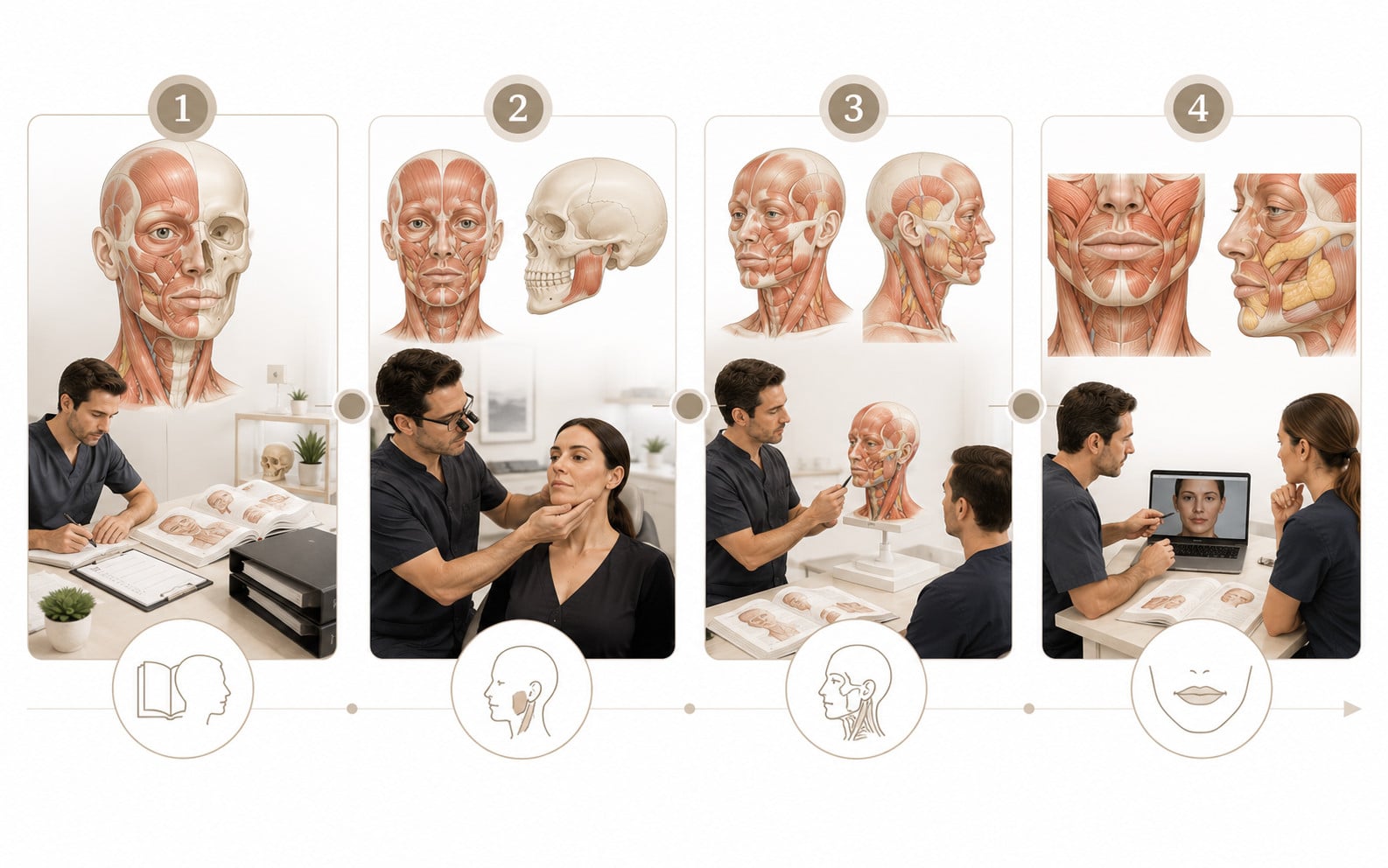
What the ODQ Actually Established: The Foundation for Every Comparison
Before any provider comparison is meaningful, the regulatory baseline has to be clear. Not a summary of it, but the actual content.
The Ordre des dentistes du Québec published its guide on botulinum toxin A and filling agents on March 27, 2025. It updated the guide on June 26, 2025, with clarifications to specific pages. It published a detailed FAQ on September 29, 2025, addressing member questions about the guide’s application. These three documents together constitute the current regulatory framework for injectable practice by Quebec dentists.
The guide establishes a four-level progressive training pathway. Level 1 is foundational theoretical training with no patient treatment authorized. Level 2 adds aesthetic upper-face botulinum toxin A and therapeutic management of bruxism. Level 3 expands to the mid and lower face, neck, and expanded therapeutics for myofascial pain and dysfunction. Level 4 introduces dermal filling agents.
Advancing from Level 2 to Level 3 requires treating a minimum of 20 patients within the Level 2 scope. The ODQ FAQ was explicit and deliberately specific about this: it is 20 patients combined across the Level 2 treatment categories, not 20 per category. A dentist who has treated 10 upper-face patients and 10 bruxism patients has met the threshold. The same principle applies when advancing from Level 3 to Level 4.
Between Level 2 and Level 3, the ODQ recommends a waiting period of approximately six months. This is described as recommended, not mandatory. The purpose is to allow the dentist to observe treatment results over the natural course of the treatment effect, accumulate experience with complications and questions, and deepen clinical judgment before expanding scope.
The guide also establishes that wherever injectable treatments are provided, the practice location must meet the same standards as a dental office, including the availability of a defibrillator. All practice locations must be declared on the ODQ roll and are subject to inspection.
When a dentist issues an individual order to a nurse for injection administration, the dentist must have performed a clinical examination, established a diagnosis, and formulated a treatment plan that includes specific injection site mapping and doses. The dentist must verify the nurse’s training level and current authorization. The dentist must be physically on site at the practice location during the session.
The guide does not currently extend to microneedling, PRP, threads, or other non-injectable facial aesthetic treatments. The ODQ has acknowledged these questions are under analysis and will be addressed separately.
The fact that shapes every meaningful provider comparison is this: the ODQ FAQ answered the question “Dois-je faire approuver mes formations par l’Ordre avant de m’y inscrire?” with a direct answer: “Non. Il suffit de respecter les exigences décrites dans le Guide.” The ODQ does not approve, certify, or accredit any training program or training provider. It defines content requirements. Each dentist is responsible for evaluating whether the course they select meets those requirements.
This statement, directly from the ODQ, invalidates a category of marketing claims that appears across multiple providers serving Quebec dentists.

What to Look For in Any Training Program: The Evaluation Framework
With the regulatory baseline established, here is a concrete framework for evaluating any training program before you register.
Does the program genuinely mirror the ODQ’s four-level structure? The ODQ’s level progression is not just an organizational convenience. Each level corresponds to an increasing level of anatomical complexity and clinical risk. Moving from the upper face to the mid and lower face introduces significantly more complex vascular anatomy. Moving into filling agents introduces the risk of intravascular injection and filler-related vascular occlusion. A program that compresses all of this into a single weekend course, or that teaches “Level 1 through 3” in a two-day session, is treating the ODQ’s framework as a branding exercise rather than a genuine clinical safety structure.
Does the program accurately describe what the ODQ does and does not provide? Any provider claiming their course is “ODQ-approved,” “ODQ-certified,” “ODQ-accredited,” or that the ODQ has formally endorsed their program is making a claim the ODQ itself directly contradicts. This is not a fine-print issue. A training provider that overstates its credentials in this foundational way should raise questions about what other aspects of its representation are similarly inaccurate.
Does the program address the 20-patient clinical experience threshold between levels? Attending a Level 2 training course does not, by itself, mean you can immediately advance to Level 3 content. You need to treat 20 patients within the Level 2 scope first. Providers who imply you can complete Levels 1-3 in a single course structure are omitting the most important part of the ODQ’s progression requirement.
Does the program teach the individual order requirements? The guide is specific about what a dentist must do before issuing an individual order to a nurse: examine the patient, establish a diagnosis, map specific injection sites and doses, verify the nurse’s training, and be on site during the session. A training program that focuses only on injection technique without teaching you how to formulate a compliant individual order leaves a significant gap in your readiness for collaborative practice.
Does the online Level 1 theory introduce foundational dermal filler concepts?
The ODQ’s published Level 1 minimum does not expressly require dermal filler theory. This criterion therefore measures added curriculum depth, not ODQ compliance. AMEQ goes beyond the published Level 1 minimum by introducing foundational hyaluronic acid dermal filler theory online during Step 1, so dentists are better oriented before later Level 4 filler education.
Who actually leads and supervises the practical training? In Quebec’s professional framework, aesthetic medicine is a medical act, and the physician’s role remains central to evaluation, diagnosis, prescribing, and complication management. When comparing programs, do not look only for whether a physician appears somewhere on the faculty list. Confirm who personally teaches and supervises your practical injections, that person’s profession, their experience practising aesthetic medicine, and their teaching experience. AMEQ’s practical dentist training is taught directly by Dr. Angelina Guzzo, BSc, PhD, MDCM, FRCPC, a physician specialist with more than 10 years of aesthetic medicine experience and more than 35 years of teaching experience.
Does the program train in small groups with genuine live-model practice? The ODQ’s guide sets clinical experience thresholds for progression because clinical competence requires real patient experience. The difference between observing a demonstration with twenty other practitioners and performing injections under direct supervision is important when comparing practical training formats.
Does the program prepare you for the full scope of obligations, not just injection technique? Dental-office location requirements, ODQ roll declarations, emergency kit and defibrillator standards, on-site presence obligations when ordering to a nurse, and the content requirements for a compliant individual order are all parts of the practice you are entering. A training program that focuses exclusively on technique and ignores these obligations leaves a significant professional-context gap.

How Botox Training Providers for Quebec Dentists Compare
Disclosure and evidence standard: AMEQ Academy publishes this comparison and competes with the providers listed below. The Pros and Cons are based on provider websites and ODQ primary sources reviewed on August 6, 2026. A point described as not publicly confirmed is not proof that a course omits it. It means the detail was not clearly stated in the public material reviewed. Dentists should request a complete syllabus and written answers before paying.
Why instructor experience matters at AMEQ: AMEQ’s dentist practical training is taught directly by Dr. Angelina Guzzo, BSc, PhD, MDCM, FRCPC. Dr. Guzzo has more than 10 years of experience practising aesthetic medicine and more than 35 years of teaching experience.
For dentists comparing programs, physician involvement alone does not show who will actually teach the practical component or how much aesthetic medicine and teaching experience that instructor brings. AMEQ’s practical teaching is provided directly by the same experienced physician educator rather than simply listing a physician as part of a broader mixed faculty.
Premier Injectors for Quebec Dentists: Pros and Cons
Premier Injectors is a Montreal academy with a mixed physician, dental, and nursing faculty. Its public catalogue offers individual levels and bundled dentist pathways. Premier lists Level 1 at CAD$1,500 with 16 hours of online theory and Level 2 at CAD$3,950 with 8 hours of theory and 16 hours of practical training. Dentists should confirm the current structure, practical exposure, model requirements, and assigned instructor directly with Premier before registering.
Pros
- Training is offered in Montreal and the public curriculum uses the ODQ’s four-level terminology.
- The Level 1 to 3 bundle publicly describes more than 32 hours of theory and more than 32 hours of supervised clinical practice with real patients.
- Premier now publishes dentist pricing, including a Level 1-2 bundle at CAD$4,950 on sale (CAD$5,450 regular) and a full Level 1-4 pathway at CAD$12,750 on sale (CAD$13,900 regular).
- The faculty includes physicians, an oral and maxillofacial surgeon, and nurses with aesthetic medicine experience.
- Observation and preceptorship options are publicly available.
Cons and points to verify
- Level 1 is listed at CAD$1,500 for 16 hours of online theory. Premier states that registration and payment are non-refundable because of limited spaces and the nature of the training. AMEQ’s online theory is not limited by physical seat count. At AMEQ, online material is non-refundable once accessed because the participant has received access to and benefited from the educational material.
- Premier’s Level 1 does not cover facial aging and medical photography, two subjects identified in the ODQ Level 1 requirements. Dentists should compare the complete Level 1 syllabus with the current ODQ guide before registering.
- Level 2 is listed at CAD$3,950 and describes 8 hours of theory plus 16 hours of practical training. The public material reviewed does not clearly state how many patients each participant is guaranteed to personally inject during those 16 practical hours or whether participants must supply their own models. Confirm both points in writing.
- The program is taught by a mixed physician, dental, and nursing faculty rather than by one identified physician educator throughout. Dentists should ask who will personally supervise their practical injections, whether that person is a physician, dentist, or nurse, and how much aesthetic medicine teaching and clinical experience that instructor has.
- The public Level 1 curriculum focuses on neuromodulators and anatomy. Foundational filler theory is not clearly listed until later training.
- The public pages reviewed did not clearly state a maximum group size for practical training.
- Premier’s Level 1-4 promotional bundle was listed at CAD$12,750 when reviewed, compared with CAD$13,900 regular. Paying the full pathway in advance creates a financial commitment to Levels 3 and 4 before the dentist has completed Levels 1 and 2 and decided whether to continue. Progression through the complete pathway may span many months because the ODQ clinical-experience requirements still apply.
- Premier offers supervision at the dentist’s own practice for CAD$4,000 while the dentist treats their own patients. AMEQ offers a comparable on-site supervision option for CAD$2,500.
- Premier also offers a CAD$2,000 observation or shadowing option in which the participant observes another practitioner injecting. For the same CAD$2,000 price, AMEQ offers a supervised injection day at the AMEQ clinic in which the dentist personally performs the injections. AMEQ can provide models, or the session can be tailored to a specific learning need when the dentist supplies suitable models.
- Preceptorship, observation, and supervised-practice services are separate offerings. Participants should confirm which forms of post-training support are included in tuition and which require additional payment.
AMEQ advantage compared with Premier Injectors: AMEQ combines a maximum of four dentists with direct practical teaching by Dr. Angelina Guzzo, who has more than 10 years of aesthetic medicine experience and more than 35 years of teaching experience. AMEQ includes foundational filler theory in Step 1, supplies models for its core Step 2 practical training, does not require dentists to prepay for Levels 3 and 4 to maintain the same combined pathway pricing, and offers lower-cost supervised options in which the dentist can personally inject under supervision.
A four dental maximum allows each dentist to get one on one advice about how to integrate botulinum toxin A into their business practice, something impossible to achieve in a group of 40 students. Dr Guzzo is an expert in filler injection and complication management, This is not the case with PTIFA.
Public sources reviewed: Premier Injectors course catalogue, Level 1 and Level 2 dentist pages, and faculty page.
PTIFA for Quebec Dentists: Pros and Cons
PTIFA is based in British Columbia and markets Quebec training through its FETAP framework. Its Quebec content is more detailed than many national providers, but its treatment of FETAP requires close scrutiny. Step 1 theoretical training is English only and purchased separately. Level 1 is listed at CAD$1,895 and Level 2 at CAD$3,990.
Pros
- PTIFA’s Quebec page describes the four-level pathway, the 20-patient progression requirement, calibrated photography, recordkeeping, and the dental-office setting.
- It offers supervised clinical training and publicly describes post-training resources.
- Journal clubs for ongoing professional development are confirmed.
- Its faculty has extensive dental facial-aesthetics experience.
Cons and points to verify
- PTIFA states that the ODQ adopted or introduced the FETAP standard. The term FETAP does not appear in the ODQ guide, June 2025 modifications, or September 2025 FAQ reviewed for this article.
- PTIFA’s Quebec page states that the ODQ requires training through a college-approved institution. The ODQ FAQ instead says dentists do not need the Order to approve their training before registration and must select a course that meets the guide.
- FETAP was developed with the Alberta dental regulator. A FETAP credential may describe alignment with that framework, but it is not evidence of ODQ approval in Quebec.
- PTIFA is dentist-led rather than physician-led throughout.
- Foundational filler theory is positioned later in the pathway rather than expressly included in the public Level 1 syllabus.
- The public material reviewed did not clearly explain the dentist’s on-site obligation when ordering treatment to a nurse or state that course completion is not automatic practice authorization.
- Day 1 of Step 2 is delivered in groups of 20 to 40 students.
- Post-training support after Step 2 is available through paid add-on courses rather than included free.
- PTIFA’s current Level 2 page requires each practitioner to provide at least one patient model and states that hands-on exposure may be more limited without one. Dentists should confirm the exact number required for their Quebec session in writing.
- At the prices reviewed, Levels 1 through 4 purchased separately total CAD$13,865 plus tax. No complete-pathway bundle was identified in the official material reviewed, so dentists should compare the full pay-as-you-go cost before committing to the pathway.
AMEQ advantage compared with PTIFA: AMEQ teaches directly against the ODQ framework without presenting an Alberta standard as an ODQ requirement. It also adds physician-led medical context, a confirmed maximum of four dentists, foundational filler theory in Step 1, models supplied by AMEQ for Step 2, and Quebec-specific post-training support.
Public sources reviewed: PTIFA Quebec requirements page, PTIFA accreditation page, and PTIFA business and clinical integration course.
CBAM for Quebec Dentists: Pros and Cons
CBAM operates from Toronto and Vancouver and markets courses in Montreal to Quebec dentists. AMEQ enjoyed its previous collaboration with CBAM, but CBAM ended the partnership. AMEQ now works independently of CBAM and offers training specifically designed for Quebec healthcare professionals. This comparison addresses CBAM’s current public materials.
Pros
- CBAM publicly offers online learning, in-person training in Montreal, live-model practice, and post-course mentorship.
- Its public materials describe instruction by physicians and other experienced healthcare professionals.
- The Quebec dentist page includes anatomy, injection technique, patient assessment, and risk management.
- A complete online foundation is listed at CAD$1,500 and covers facial anatomy, injection principles, and patient safety.
Cons and points to verify
- CBAM’s public Quebec content says the ODQ has “approved” Botox and fillers and describes programs as fully aligned with ODQ requirements. The ODQ FAQ states that it does not approve a dentist’s training before registration and that the dentist must select education that meets the guide.
- The public five-day diploma pathway says participants can complete Levels 1 to 3 and includes Botox, fillers, PRP, and laser content. That structure does not clearly preserve the ODQ’s required clinical experience gate before Level 3, and filler treatment belongs later in the ODQ pathway.
- The public page instructs participants to complete training, receive certification, and then start offering aesthetic services. That sequence does not explain that training alone is not automatic practice authorization.
- The public materials reviewed did not clearly explain the dentist’s on-site obligation when ordering to a nurse, the dental-office setting and defibrillator requirements, or the approximately six-month interval recommended before Level 3.
- The public instructor model is not clearly physician-led throughout every theoretical and practical component.
- The online foundation does not cover facial aging or medical photography and is not specifically designed to meet ODQ requirements.
- CBAM does not publicly confirm a one-day in-person theoretical training component for dentists.
- The complete-program offer reviewed displayed CAD$9,000 with CAD$12,500 crossed out, while individual hands-on step descriptions also reference Step 1 being included. This creates ambiguity about the exact pay-as-you-go total and what is included at each step. Confirm the current written pricing and inclusions before registering.
AMEQ advantage compared with CBAM: AMEQ uses a four-dentist maximum, direct practical teaching by Dr. Angelina Guzzo, explicit teaching on the 20-patient progression gate and practice obligations, and a clear statement that the ODQ does not approve providers or grant automatic authorization after a commercial course.
Public source reviewed: CBAM Quebec dentist training page.
Bevel Education and Dre Mélissa Vellucci: Pros and Cons
Bevel Education offers a Quebec dentist pathway led by Dre Mélissa Vellucci, MD, in the Greater Montreal area. Its public materials describe a 16-hour Level 1 course, a Level 2 course combining eight hours of theory with eight hours of private clinical coaching, and additional Level 3 education.
Pros
- The program is physician-led by Dre Vellucci and is designed specifically for dentists following the Quebec pathway.
- Level 1 is delivered in a restricted microgroup, while Level 2 includes one-on-one supervision at the participant’s own clinic.
- The Level 2 page states that the participant receives practical coaching on six initial patients and access to a six-month group chat while building experience toward the ODQ’s 20-patient gate.
- The provider states that its training is independent of industry sponsorship.
Cons and points to verify
- Bevel publicly lists Level 1 at CAD$2,750 plus taxes and Level 2 at CAD$8,500 plus taxes. The combined initial pathway is therefore CAD$11,250 plus taxes, more than twice AMEQ’s listed CAD$4,995 Step 1 and Step 2 package.
- Bevel’s Level 2 is publicly restricted to dentists who also completed Bevel’s Level 1, which may prevent a dentist from applying equivalent prior education toward that pathway without repeating the first level.
- The Level 1 page reviewed says the next dates are expected at the beginning of 2027. The Level 2 page still displays a March 14, 2026 theory date, so current availability and scheduling require direct confirmation.
- The current homepage reviewed publicly presents Levels 1, 2, 3, and a special Level 3 edition, but it does not clearly present a complete Level 4 course, current Level 4 pricing, or a full published cost for the four-level pathway.
- The website states an objective of helping participants become fully confident, competent, and autonomous when injecting alone. That marketing language should not be interpreted as automatic practice authorization or a guarantee of competence after completing a commercial course.
- The public pages reviewed did not clearly explain the dentist’s on-site obligation when issuing an order to another professional, the defibrillator requirement, or every dental-office condition described by the ODQ.
AMEQ advantage compared with Bevel Education: AMEQ publishes a substantially lower initial pathway price, includes online Step 1 theory, supplies models for its two-day Step 2 practical component, limits cohorts to four dentists, and teaches the Quebec progression and practice obligations explicitly.
Public sources reviewed: Bevel Education dentist pathway, Bevel Level 1, and Bevel Level 2.
Face MD Academy for Quebec Dentists: Pros and Cons
Face MD Academy is the education division of Clinique Face MD in Montreal. Its public dentist materials identify Dr. Sami Moubayed and Dre Marie-Laure Desroches as the physician instructors and promote Level 1, Level 2, and Level 3 education for healthcare professionals and dentists.
Pros
- The program is physician-led and draws on facial plastic surgery, head-and-neck anatomy, family medicine, and aesthetic medicine experience.
- The public Level 2 description combines theory with supervised practical education and personalized feedback.
- The provider states that Level 2 includes practice involving two volunteer models and that groups are limited in size.
- Face MD states theoretical groups are limited to 8 to 10 participants and practical groups to 4 to 5, with a 1:4 to 1:5 teacher-to-student ratio.
- Training is delivered in Montreal, and the public Level 1 listing identifies a 16-hour facial anatomy and injectable-products foundation.
Cons and points to verify
- Face MD requires each participant to bring two volunteer models for the practical session. Its public bundle page also states that the models pay 50% of the regular treatment price. AMEQ supplies the practical models for its Step 2 cohorts.
- The public Level 1 and Level 2 bundle page reviewed on August 6, 2026 stated that the bundle was not available for purchase, while a stand alone Level 1 course remained listed separately at CAD$1,723.85. Dentists should confirm whether Level 1 must be purchased separately, completed through another provider, or supplied directly by Face MD for their chosen Level 2 session.
- Face MD publishes theoretical groups of 8 to 10 participants and practical groups of 4 to 5, with a 1:4 to 1:5 teacher-to-student ratio. AMEQ limits both Step 2 days to four dentists with a 1:4 teacher-to-student ratio.
- The public academy page reviewed did not clearly state the ODQ’s 20-patient progression gate, the approximately six-month progression interval, the dentist’s on-site obligation when ordering to another professional, or the dental-office and defibrillator requirements.
- The academy homepage reviewed lists Level 1, a Level 1 and Level 2 bundle, and Level 3, but it does not clearly list a Level 4 filling-agent course for dentists.
- The academy states that graduates meet the highest standards and maintain complete regulatory compliance, and it describes a certificate attesting acquired competencies. Those statements do not replace the dentist’s responsibility to verify the full syllabus against the current ODQ guide and do not create automatic practice authorization.
- Post-training support terms while a dentist builds the required patient experience were not clearly described on the public academy page reviewed.
AMEQ advantage compared with Face MD Academy: AMEQ provides a complete Step 1 and Step 2 pathway, supplies practical models, publishes a maximum of four dentists with a 1:4 teacher-to-student ratio, states the complete initial pathway price, teaches the ODQ progression and practice obligations explicitly, and provides continuing access to Dr. Guzzo and the AMEQ clinical team. Face MD offers strong physician credentials, but participants must bring two volunteer models and should confirm the current Level 1 purchase pathway, total bundle price, progression rules, Level 4 availability, and continuing support in writing.
AMEQ offers in house theoretical training in both English and French (with 16 UFC credits). The content was specifically create for dentist to meet the ODQ requirements. Face MD requires students to subscribe to level 1 theory outside their academy and doesn’t describe whether the step 1 they recommend complies with the ODQ guidelines.
Public sources reviewed: Face MD Academy and Face MD training overview.
Derma Institute for Quebec Dentists: Pros and Cons
Derma Institute is based in Markham, Ontario and markets foundation, advanced, combined, and diploma programs to Canadian healthcare professionals, including dentists.
Pros
- The foundation and advanced courses publicly describe live-model practice and small-group instruction.
- The provider describes clinical mentoring after training.
- Its physician continuing education activity may qualify for Royal College Maintenance of Certification credits where applicable.
Cons and points to verify
- The Royal College and Canadian Nurses Association references concern continuing education recognition. They do not constitute ODQ approval or establish that the program satisfies the Quebec dentist pathway.
- The public structure uses Foundation, Advanced, Combined, and Level 7 diploma labels rather than the ODQ’s four levels.
- Training is primarily delivered in Ontario and is framed for a general Canadian market rather than Quebec’s specific ODQ framework.
- The public dentist materials reviewed did not clearly address the 20-patient gates, the dentist’s on-site obligation when ordering to a nurse, dental-office and defibrillator requirements, or the distinction between training and practice authorization.
- The short combined format teaches toxin and filler procedures together, which does not mirror the ODQ sequence that places practical filler treatment at Level 4.
- A separate post-course Practical Injecting Day is publicly offered at CAD$1,795 plus tax, where participants inject live models under supervision. No Quebec training location for this option was identified in the material reviewed.
AMEQ advantage compared with Derma Institute: AMEQ is delivered in Quebec, follows the ODQ level structure, separates practical filler education until Level 4, and teaches Quebec-specific clinical and practice obligations.
Public source reviewed: Derma Institute dentist training page.
Zeeba Education for Quebec Dentists: Pros and Cons
Zeeba is a Quebec dental continuing education provider with a public pathway covering Level 1 online study and in-person Levels 2, 3, and 4 with live patients.
Pros
- The public course structure mirrors the ODQ’s four levels.
- Training is delivered in Montreal and includes supervised live-patient practice.
- Zeeba uses measured compliance language rather than claiming ODQ approval.
- Its faculty includes dental specialists and a physician for later filler education.
Cons and points to verify
- Levels 1 to 3 are not physician-led throughout. The program’s core early instruction is dental-specialist-led.
- The public page reviewed did not state a maximum class size of four.
- The 20-patient progression gate was not clearly stated on the public course page reviewed.
- The public material did not clearly address the dentist’s on-site obligation, dental-office and defibrillator requirements, or the distinction between training and practice authorization.
- Foundational dermal filler theory was not clearly listed in the public Level 1 syllabus.
- Ongoing case support while participants accumulate the patient experience required for later levels was not clearly described.
- The pathway reviewed included 2025 and early-2026 dates. Dentists should confirm current Quebec session dates and current pricing before registering.
AMEQ advantage compared with Zeeba: AMEQ is physician-led by Dr. Guzzo, limits each dentist cohort to four participants, includes foundational filler theory during Step 1, and publicly describes ongoing clinical support after training.
Public source reviewed: Zeeba Botox in Dentistry pathway.
McGill Continuing Dental Education: Pros and Cons
McGill CDE offers Level 1 through Level 4 education in Montreal under Dr. Firoozeh Samim, a dental specialist in oral medicine and orofacial pain.
Pros
- The university setting provides institutional continuing education infrastructure.
- The public program follows a level-by-level structure and includes live-patient training.
- Dr. Samim’s oral medicine and orofacial pain background is relevant to bruxism, temporomandibular dysfunction, and myofascial pain.
- ODQ continuing education units are publicly listed.
Cons and points to verify
- The program is dental-specialist-led, not physician-led throughout.
- The public listing reviewed did not state a four-participant maximum or describe how injection opportunities are distributed within each cohort.
- The public listing did not clearly state the 20-patient gate before Level 3 or Level 4.
- The dentist’s on-site obligation, dental-office and defibrillator standards, and the statement that training is not automatic authorization were not clearly visible in the public listing reviewed.
- Foundational filler theory in Level 1 and ongoing post-course case support were not clearly confirmed in the public listing.
- Current individual tuition for each level and the full four-level pathway total were not published on the accessible course listing reviewed. Dentists should request the complete pathway cost before registering.
AMEQ advantage compared with McGill CDE: AMEQ provides physician-led medical and pharmacological context, a published maximum of four dentists, direct instruction by the same lead educator, early filler theory, and continuing access to the AMEQ clinical team.
Public source reviewed: McGill CDE course listing.
Mediluxe for Quebec Dentists: Pros and Cons
Mediluxe is a Montreal clinic with a physician instructor and a public four-level dentist pathway that uses careful language about compliance with ODQ requirements.
Pros
- The program is delivered in Montreal and publicly follows four levels.
- Its practical sessions use live models.
- The website describes small groups and personalized support.
- The page does not claim ODQ certification or approval.
Cons and points to verify
- The public page does not state the maximum number of participants in each small group.
- The 20-patient progression gate was not clearly stated in the public course description reviewed.
- The public page did not clearly explain the on-site obligation when a dentist orders treatment to a nurse, the dental-office and defibrillator requirements, or that training is not automatic practice authorization.
- Foundational filler theory was not listed in the Level 1 description.
- Ongoing post-training clinical support while participants build their required patient experience was not clearly described.
- The English dentist page contains an inconsistent heading referring to CMQ compliance even though the body refers to ODQ requirements. Prospective participants should request the full Quebec dentist syllabus in writing.
- Current individual level pricing and the total four-level pathway cost were not publicly available on the dentist training page reviewed.
AMEQ advantage compared with Mediluxe: AMEQ publishes a specific four-dentist limit, identifies the lead instructor for the practical component, includes filler theory in Step 1, and describes post-course access to Dr. Guzzo and the clinical team.
Public source reviewed: Mediluxe dentist training page.
Institut Dentaire International, IDI: Pros and Cons
IDI operates at Quartier DIX30 in Brossard and offers a French-language modular pathway for the ODQ levels.
Pros
- The public program is organized into separate modules corresponding to the ODQ levels.
- Level 2 and later modules include eight hours of theory and eight hours of practical training, listed as 24 UFC for dentists.
- Live-patient practice is included.
- The faculty includes a maxillofacial surgeon, which provides relevant dental surgical and anatomical depth.
Cons and points to verify
- The pathway is not physician-led throughout. Its distinguishing clinical expertise is primarily dental and maxillofacial.
- The public module pages reviewed did not state a maximum group size.
- The 20-patient gate, dentist on-site obligation, dental-office and defibrillator standards, and training-versus-authorization distinction were not clearly visible on the Level 2 page reviewed.
- Foundational filler theory was not clearly listed as part of the public Level 1 description reviewed.
- The program is principally presented in French. Dentists seeking bilingual instruction should confirm the language available for each module.
- Modules are priced separately. Prospective participants should request the complete cost of the full Level 1 to 4 pathway, including models, products, reassessments, and any additional support.
AMEQ advantage compared with IDI: AMEQ combines bilingual Quebec delivery with the medical perspective of a specialist in anesthesiology, a four-dentist maximum, included models for Step 2, Level 1 filler foundations, and ongoing post-training case support.
Public source reviewed: IDI Level 2 course page.
Académie Dentaire and La Fac Montréal: Pros and Cons
The approved source draft describes Académie Dentaire as a multidisciplinary program involving physician and nursing faculty. The current public program located for this review is presented under La Fac Montréal and lists dentist Levels 1, 2, and 3.
Pros
- The program is delivered in Montreal and uses measured language about taking ODQ guidelines into consideration.
- Level 1 publicly lists 16 hours of online theory, and Level 2 lists 16 hours of practical education for the upper face and bruxism.
- The multidisciplinary faculty includes medical and nursing perspectives.
- Mentorship options are publicly offered.
Cons and points to verify
- The program is a mixed-faculty model rather than physician-led throughout by one instructor.
- A dentist Level 4 offering was not clearly listed in the current public program block reviewed.
- The public page did not clearly state a maximum class size, the 20-patient progression gate, the on-site obligation, dental-office and defibrillator standards, or that training is not automatic practice authorization.
- Foundational filler theory was not clearly listed in the public Level 1 outline.
- Mentorship is listed as a separate paid service. Participants should confirm what support is included with the course tuition.
AMEQ advantage compared with this program: AMEQ confirms one physician lead for practical dentist education, a maximum of four dentists, a published Level 1 to 4 progression, filler foundations during Step 1, and included post-training access for clinical questions.
Public source reviewed: La Fac Montréal program page.
ConfiDentist: Pros and Cons
ConfiDentist is based in North York, Ontario. The public listing reviewed was a single-day botulinum toxin course with six CE credits and a CAD$1,800 price, but the dated course was out of stock.
Pros
- The course outline includes lecture, observation, and hands-on components.
- The entry price is lower than a multi-level Quebec pathway.
Cons and points to verify
- The available listing was for a past Ontario course and was out of stock.
- A one-day, six-credit course does not mirror the ODQ’s four-level progressive structure.
- The public listing did not contain Quebec-specific ODQ content, 20-patient progression requirements, individual-order teaching, on-site obligations, or dental-office standards.
- Prospective participants would need separate Quebec-aligned education before assuming the course corresponds to the ODQ pathway.
AMEQ advantage compared with ConfiDentist: AMEQ provides a current Quebec-specific Step 1 and Step 2 pathway, two practical days, a maximum of four dentists, live models supplied by AMEQ, and explicit ODQ framework education.
Public source reviewed: ConfiDentist course listing.
TIDE, The Institute for Dental Excellence: Pros and Cons
TIDE offers a one-day therapeutic botulinum toxin course in Toronto that is explicitly framed around the Royal College of Dental Surgeons of Ontario.
Pros
- The course focuses on therapeutic applications such as temporomandibular disorders and bruxism.
- It includes theory, examination, and live-patient hands-on training.
- The Ontario regulatory context is stated clearly.
Cons and points to verify
- The course is designed for the Ontario RCDSO framework, not the ODQ framework.
- It is a one-day, seven-credit course rather than a four-level Quebec pathway.
- The public page does not address the Quebec 20-patient gates, aesthetic upper-face progression, dentist orders to nurses, on-site presence, or dental-office standards.
- Completion should not be treated as evidence that the course satisfies ODQ Level 1 or Level 2 content.
AMEQ advantage compared with TIDE: AMEQ is designed for ODQ members, covers the Quebec aesthetic and therapeutic pathway, and includes Quebec-specific regulation, documentation, collaboration, and progression requirements.
Public source reviewed: TIDE therapeutic Botox course.
APT Injection Training: Pros and Cons
APT targets multiple local search markets but states that its in-person courses are currently held only at its Oakville, Ontario facility. Its dental toxin and filler course is a one-day format led through a faculty headed by a nurse, with physician medical directors on the broader team.
Pros
- The dental course publicly states a two-to-one trainee-to-trainer ratio.
- Pre-course theory and hands-on practice are included.
- The faculty includes experienced nurses and physicians.
Cons and points to verify
- The provider’s own page states that in-person training is currently available only in Oakville, Ontario.
- The one-day dental course combines toxin and filler content and does not mirror the ODQ’s four-level sequence.
- The program is not physician-led throughout.
- The public course page reviewed does not teach the Quebec-specific 20-patient gates, on-site dentist obligation, dental-office and defibrillator standards, or the distinction between training and practice authorization.
- Location-targeted pages should not be interpreted as proof that training is delivered in Quebec.
AMEQ advantage compared with APT: AMEQ trains dentists in Quebec under the ODQ pathway, separates practical filler training until Level 4, and provides direct physician instruction, Quebec regulatory content, and a four-participant maximum.
Public sources reviewed: APT dental course page and APT faculty page.
University of Alberta Aesthetics Program: Pros and Cons
The University of Alberta offers a structured neuromodulator and filler program within its School of Dentistry.
Pros
- The program has university continuing education infrastructure and a structured, progressive format.
- It offers bilingual components and supervised clinical education.
- Its dentistry faculty has substantial neuromuscular and head-and-neck experience.
Cons and points to verify
- The program is based in Alberta and is organized for Alberta’s dental environment.
- Alignment with Alberta or FETAP standards does not establish correspondence with every ODQ content and practice requirement.
- Quebec dentists must independently compare the syllabus against the ODQ guide, including the 20-patient gates, dental-office requirements, orders to nurses, and on-site presence.
- Travel, provincial registration requirements for treating models, and total pathway costs should be confirmed before registration.
AMEQ advantage compared with the University of Alberta: AMEQ eliminates out-of-province regulatory translation and travel, teaches the Quebec framework directly, and provides ongoing support within the province where the dentist will practise.
Public source reviewed: University of Alberta neuromodulator program.
Step 1 and Step 2: What Each Provider Confirms
The comparison table separates the two phases of training. Step 1 is the online theoretical course. Step 2 is the in-person component, delivered over two days with Day 1 theory and Day 2 practical training.
AMEQ: Step 1 is produced by AMEQ in English and French, included with the Step 2 purchase, and provides 16 UFC. Step 2 is delivered over two in-person days with a maximum of four dentists, a 1:4 teacher-to-student ratio, and models supplied by AMEQ.
Premier Injectors: Level 1 is CAD$1,500 and provides 16 hours of online theory. Level 2 is CAD$3,950 and describes 8 hours of theory and 16 hours of practical training. Prospective dentists should confirm the number of patients they will personally inject, whether they must supply models, the maximum group size, and who will supervise their practical training.
PTIFA: Level 1 is CAD$1,895 and Level 2 is CAD$3,990, in English only. Day 1 of Step 2 runs with 20 to 40 students. Journal clubs are confirmed, post-training support after Step 2 is available through paid courses, and the participant model requirement should be confirmed for the selected session.
CBAM: The online foundation is CAD$1,500 and covers facial anatomy, injection principles, and patient safety. It does not cover facial aging or medical photography, is not specifically designed to meet ODQ requirements, and CBAM does not confirm a one-day in-person theoretical training component.
Face MD: Theoretical groups are limited to 8 to 10 participants, practical groups to 4 to 5, with a 1:4 to 1:5 teacher-to-student ratio. Participants bring two volunteer models. Face MD describes this as: “Les groupes théoriques sont limités à 8-10 participants, tandis que les groupes pratiques sont limités à 4-5 afin d’assurer un apprentissage personnalisé et intensif.”
Bevel Education: Offers the theoretical course, but at the highest published cost in this comparison.
Zeeba and the remaining providers: Group sizes, bilingual delivery, and included support are not always clearly published. Request written confirmation before registering.
Quebec Dentist Injectable Training Provider Unified Comparison Table
Step 1 and Step 2 are separated so the two phases of training are easier to compare. How to use the table: swipe or scroll horizontally to compare all providers. The evaluation criterion stays visible on the left. A point marked not publicly confirmed is not proof that a course omits it. It means the detail was not clearly stated in the public material reviewed.
| Evaluation criterion | AMEQ | Premier Injectors | PTIFA | CBAM | Bevel Education | Face MD Academy | Derma Institute | Zeeba | McGill CDE | Mediluxe |
|---|---|---|---|---|---|---|---|---|---|---|
| Step 1Theoretical training · Level 1 | ||||||||||
| Step 1 theoretical course included with Step 2 | Confirmed Produced by AMEQ in English and French, included with the Step 2 purchase, designed for ODQ Level 1, and provides 16 UFC. | Confirmed Level 1 is CAD$1,500 and provides 16 hours of online theory. It is sold separately from Level 2. | Not publicly confirmed Purchased separately; English only; not designed specifically for the ODQ but described by PTIFA as meeting the requirements. | Not publicly confirmed English only. Online foundation is CAD$1,500, is not specifically designed for dentists, and no one-day in-person theoretical component was confirmed. | Confirmed Offered as part of the pathway. Level 1 and Level 2 together are CAD$11,250 plus taxes. | Partly confirmed A stand alone Level 1 course is publicly listed. Confirm the current relationship between Level 1 and the selected Level 2 session. | Not publicly confirmed Confirm whether theory is included and whether it is dentist-specific. | Confirmed Level 1 is an online module. Confirm whether it is included with the selected Level 2 workshop. | Not publicly confirmed Confirm the current course structure and inclusion. | Not publicly confirmed Confirm the current course structure and inclusion. |
| Step 1 theoretical course in English and French | Confirmed Produced by AMEQ in English and French. | Not publicly confirmed French delivery was not confirmed in the material reviewed. | No English only. | No Online foundation reviewed in English only. | Not publicly confirmed Bilingual delivery was not confirmed. | Not publicly confirmed Confirm language availability for the selected course. | Not publicly confirmed Confirm language availability. | Not publicly confirmed Confirm language availability. | Not publicly confirmed Confirm language availability. | Not publicly confirmed Confirm language availability. |
| Step 2In-person training · Level 2 | ||||||||||
| Maximum number of students, Day 1 theoretical course | Confirmed 4. | Not publicly confirmed Maximum group size not clearly stated. Confirm directly with Premier. | Confirmed 20 to 40 students. | Not publicly confirmed A one-day in-person theoretical course was not confirmed. The online foundation does not cover facial aging or medical photography. | Partly confirmed Microgroup language is used, but the exact maximum was not published. | Confirmed Theoretical groups of 8 to 10 participants. | Not publicly confirmed Not published. | Not publicly confirmed Not published. | Not publicly confirmed Not published. | Not publicly confirmed Not published. |
| Maximum number of students, Day 2 practical course | Confirmed Maximum of four dentists with a 1:4 teacher-to-student ratio. | Not publicly confirmed No fixed maximum was confirmed for the practical component. Ask who will supervise the session and how many participants will share that instructor. | Not publicly confirmed No fixed four-person maximum confirmed. | Partly confirmed A 1:4 to 1:5 instructor ratio has been described in some CBAM material, but the selected dentist session should be confirmed. | Confirmed One-on-one Level 2 clinical coaching is publicly described. | Confirmed Practical groups of 4 to 5 participants with a 1:4 to 1:5 teacher-to-student ratio. | Partly confirmed Small groups described; fixed maximum not confirmed. | Not publicly confirmed Fixed maximum not published. | Not publicly confirmed Fixed maximum not published. | Partly confirmed Small groups described; fixed maximum not published. |
| Supervised live-model practice | Confirmed Supervised live-model practical education with models supplied by AMEQ. | Confirmed Level 2 describes 16 hours of practical training. Confirm the number of patients each participant personally injects. | Confirmed Supervised clinical training described. | Confirmed Live-model practice described. | Confirmed One-on-one coaching on six initial patients. | Confirmed Practical education with volunteer models. | Confirmed Live-model practice described. | Confirmed Live-patient practical education described. | Confirmed Live-patient training described. | Confirmed Live-model sessions described. |
| Participant must supply models for Step 2 | Confirmed No. AMEQ supplies the practical models. Participants may also bring suitable models if they wish. | Not publicly confirmed Confirm directly whether Premier supplies models or requires participants to bring them. | Confirmed Yes. At least one patient model is required. Confirm the exact Quebec-session requirement. | Not publicly confirmed Model responsibility not clearly confirmed. | Partly confirmed Level 2 coaching is performed with the dentist’s own initial patients. | Confirmed Yes. Each participant brings two volunteer models, and the public bundle page states that models pay 50% of the regular treatment price. | Not publicly confirmed Confirm model responsibility. | Confirmed Participants are required to bring patients for specified practical sessions. | Not publicly confirmed Confirm model responsibility. | Not publicly confirmed Confirm model responsibility. |
| Initial practical exposure | Confirmed Live-model injections under direct supervision with a maximum of four dentists. | Partly confirmed Level 2 describes 16 hours of practical training, but the guaranteed number of patients each participant personally injects is not publicly confirmed. | Partly confirmed Practical injection experience is described and the participant supplies at least one model. Confirm individual exposure for the selected session. | Not publicly confirmed Per-participant exposure is not clearly published. | Confirmed Six initial patients with one-on-one coaching. | Confirmed Two volunteer models per participant. | Not publicly confirmed Per-participant exposure not published. | Not publicly confirmed Per-participant exposure not published. | Not publicly confirmed Per-participant exposure not published. | Not publicly confirmed Per-participant exposure not published. |
| Program and regulation | ||||||||||
| Lead educator personally teaches practical training | Confirmed Dr. Angelina Guzzo personally teaches the practical dentist training. She has more than 10 years of aesthetic medicine experience and more than 35 years of teaching experience. | Partly confirmed Mixed physician, dental, and nursing faculty. Confirm who personally supervises the selected practical session and that educator’s profession and experience. | No Core program is dentist-led rather than physician-led throughout. | Partly confirmed Physicians and other healthcare professionals are described, but the same physician educator is not clearly confirmed throughout the practical pathway. | Confirmed Led by Dre Mélissa Vellucci, MD. | Confirmed Physician instructors are publicly identified. | Not publicly confirmed Physician leadership for the complete pathway was not confirmed. | No Core early pathway is dental-specialist-led. | No Dental-specialist-led. | Confirmed Physician instructor publicly identified. |
| Quebec delivery | Confirmed Montreal and Saint-Sauveur. | Confirmed Montreal. | Confirmed Markets Quebec-specific training. | Confirmed Montreal sessions marketed. | Confirmed Greater Montreal area. | Confirmed Montreal. | No Based in Markham, Ontario. | Confirmed Montreal. | Confirmed Montreal. | Confirmed Montreal. |
| Four-level ODQ pathway | Confirmed Progression from Levels 1 to 4 is stated. | Partly confirmed ODQ terminology is used, but purchasing a bundle does not remove the ODQ clinical-experience progression requirements. | Confirmed Four-level pathway described. | Partly confirmed A five-day Levels 1 to 3 pathway does not clearly preserve the clinical-experience gate before Level 3. | Partly confirmed Levels 1 to 3 are public; current Level 4 is not clearly published. | Partly confirmed Levels 1 to 3 are promoted; Level 4 is unclear. | No Public labels do not mirror the ODQ pathway. | Confirmed Levels 1 to 4 publicly described. | Confirmed Levels 1 to 4 publicly described. | Confirmed Four levels publicly described. |
| Level 1 filler foundations beyond ODQ minimum | Confirmed Foundational hyaluronic acid dermal filler theory is included online as additional preparation for later training. | Not publicly confirmed Foundational filler theory is not clearly listed in Premier’s Level 1 curriculum. | Not publicly confirmed Not expressly included in the public Level 1 syllabus. | Partly confirmed Filler content appears within broader training, but the sequence and Level 1 placement require clarification. | Not publicly confirmed Not clearly confirmed as part of Level 1. | Confirmed Level 1 identifies injectable-product foundations. | Partly confirmed Filler content is combined early in some programs. | Not publicly confirmed Not clearly confirmed. | Not publicly confirmed Not clearly confirmed. | Not publicly confirmed Not clearly confirmed. |
| Avoids ODQ approval or certification claims | Confirmed Explicitly states that the ODQ does not approve providers. | Partly confirmed Dentists should verify all compliance claims against ODQ primary sources. | Partly confirmed Uses FETAP and college-approved language that requires scrutiny against the ODQ’s own statements. | No Public Quebec content has used ODQ-approved or fully aligned language. | Partly confirmed Compliance language should not be interpreted as ODQ approval. | Partly confirmed Course titles and compliance language require careful reading. | Confirmed No ODQ approval claim found. | Confirmed Uses measured correspondence language. | Confirmed No ODQ approval claim found. | Confirmed Uses measured compliance language. |
| Does not present FETAP as an ODQ requirement | Confirmed AMEQ teaches the ODQ framework directly. | Confirmed No FETAP-as-ODQ claim found. | No Quebec materials present FETAP language requiring scrutiny. | Confirmed No FETAP-as-ODQ claim found. | Confirmed No FETAP-as-ODQ claim found. | Confirmed No FETAP-as-ODQ claim found. | Confirmed No FETAP-as-ODQ claim found. | Confirmed No FETAP-as-ODQ claim found. | Confirmed No FETAP-as-ODQ claim found. | Confirmed No FETAP-as-ODQ claim found. |
| States that training is not automatic authorization | Confirmed Explicitly stated. | Not publicly confirmed Not clearly stated in the material reviewed. | Not publicly confirmed Not clearly stated. | No Public sequence suggests certification followed by offering services without clearly explaining the additional ODQ practice requirements. | Partly confirmed Autonomy language should not be interpreted as automatic authorization. | Not publicly confirmed Not clearly stated. | Not publicly confirmed Not clearly stated. | Partly confirmed Uses measured language, but confirm the distinction. | Not publicly confirmed Not clearly stated. | Not publicly confirmed Not clearly stated. |
| Price and support | ||||||||||
| Initial Level 1 and Level 2 price | Confirmed CAD$4,995 regular tuition. | Confirmed Level 1-2 bundle CAD$4,950 promotional, CAD$5,450 regular. Level 1 is CAD$1,500 and Level 2 is CAD$3,950 separately. | Confirmed Level 1 CAD$1,895; Level 2 CAD$3,990. | Partly confirmed Online foundation CAD$1,500. Complete-program pricing reviewed displayed CAD$9,000 with CAD$12,500 crossed out. Request current inclusions. | Confirmed CAD$11,250 plus taxes for Level 1 and Level 2. | Partly confirmed Stand alone Level 1 listed at CAD$1,723.85. Current Level 1-2 bundle availability and price should be confirmed. | Not publicly confirmed Request the current comparable total. | Not publicly confirmed Current comparable total should be confirmed. | Not publicly confirmed Request the current comparable total. | Not publicly confirmed Request the current comparable total. |
| Full-pathway price without an advance bundle commitment | Confirmed CAD$12,995 at current individual prices: CAD$4,995 for Levels 1 and 2, CAD$4,000 for Level 3, and CAD$4,000 for Level 4. No advance Level 1-4 bundle purchase is required. | Partly confirmed Full Level 1-4 bundle listed at CAD$12,750 promotional and CAD$13,900 regular. Purchasing the complete package creates an advance financial commitment to later levels. ODQ progression requirements still apply. | Confirmed Levels are individually priced. Current pay-as-you-go total reviewed: CAD$13,865 plus tax. No required complete-pathway bundle was identified. | Partly confirmed Steps may be selected separately, but exact pay-as-you-go pricing is ambiguous because some hands-on descriptions also state that Step 1 is included. | Partly confirmed Levels 1 and 2 are individually priced. Full current Level 1-4 pricing is not publicly confirmed. | Partly confirmed Individual courses are available, but a complete current Level 1-4 total is not publicly confirmed. | Not directly comparable Individual courses and packages are available, but the program does not mirror the ODQ four-level pathway. | Partly confirmed Levels are individually priced, but current dates and prices should be reconfirmed. | Partly confirmed Levels are presented flexibly, but the complete pay-as-you-go total is not publicly published. | Not publicly confirmed Complete pathway pricing and bundle structure were not clearly published. |
| Lower-cost supervision at the dentist’s own practice | Confirmed CAD$2,500. The dentist treats their own patients under AMEQ supervision. | Confirmed CAD$4,000 for supervision at the dentist’s business while the dentist treats their own patients. | Not publicly confirmed A directly comparable instructor-at-your-practice service and price were not identified. | Not publicly confirmed Mentorship and clinic-day options are described, but a directly comparable instructor-at-the-dentist’s-practice service with published pricing was not confirmed. | Partly confirmed Level 2 includes private one-on-one supervision in the dentist’s own clinic for initial patients. It is part of Level 2 rather than a separate post-course service. | Not publicly confirmed No directly comparable own-practice post-course service was identified. | No comparable public service identified One-on-one and refresher options reviewed are delivered at Derma locations rather than the participant’s practice. | Not publicly confirmed No directly comparable own-practice service was confirmed. | Not publicly confirmed No directly comparable own-practice service was confirmed. | Not publicly confirmed No directly comparable own-practice service was confirmed. |
| Dentist performs injections during clinic-based support | Confirmed CAD$2,000 supervised injection day at the AMEQ clinic. The dentist is the injector. AMEQ can provide models or tailor the session to a specific need when suitable models are supplied. | No for the CAD$2,000 option reviewed Premier’s CAD$2,000 option is observation or shadowing in which the participant watches another practitioner inject. | Partly confirmed A participant may request an additional clinical day to inject alongside an instructor, subject to availability. A current Quebec fee was not publicly confirmed. | Partly confirmed Optional Clinic Days describe students working on their own patients with one-on-one support. Price and Quebec dentist eligibility require confirmation. | Partly confirmed The dentist personally treats initial patients under one-on-one supervision in their own clinic during Level 2. A separate post-course clinic-based day was not publicly identified. | Not publicly confirmed as post-course support Participants inject volunteer models during Level 2, but a separate post-course supervised injection day was not identified. | Confirmed Practical Injecting Day is listed at CAD$1,795 plus tax. Participants inject live models under supervision. No Quebec training location was identified. | Not publicly confirmed as post-course support Participants inject patients during some workshops, but a separate post-course supervised clinic day was not identified. | Not publicly confirmed as post-course support Supervised administration is included in practical levels, but no separate post-course clinic day was identified. | Not publicly confirmed Supervised live-model practicals are described, but a separate post-course clinic day, price, and participant role were not clearly published. |
| Post-training support | Confirmed Included at no additional cost: ongoing access to Dr. Guzzo and the AMEQ clinical team for training-related clinical questions. | Partly confirmed Preceptorship, observation, and supervised-practice services are promoted, but some are separate paid services. | Confirmed Available through paid add-on courses after Step 2. | Partly confirmed Post-course mentorship publicly described; cost and scope should be confirmed. | Confirmed Six-month group chat publicly described. Confirm whether all support is included in current tuition. | Partly confirmed Educational resources described; ongoing case support terms remain unclear. | Confirmed Clinical mentoring publicly described. Confirm cost inclusion. | Partly confirmed Support described; scope and duration require confirmation. | Not publicly confirmed Ongoing case support not clearly published. | Partly confirmed Personalized support described; confirm exact scope. |
| Journal clubs for ongoing professional development | Confirmed AMEQ launches journal clubs in September 2026. | Not publicly confirmed Not identified in the material reviewed. | Confirmed Journal club confirmed. | Not publicly confirmed Not identified in the material reviewed. | Not publicly confirmed Not identified in the material reviewed. | Not publicly confirmed Not identified in the material reviewed. | Not publicly confirmed Not identified in the material reviewed. | Not publicly confirmed Not identified in the material reviewed. | Not publicly confirmed Not identified in the material reviewed. | Not publicly confirmed Not identified in the material reviewed. |
Source note: Provider websites and ODQ primary sources were reviewed on August 6, 2026. Selected Premier Injectors and AMEQ details were further reviewed on August 7, 2026 following Dr. Angelina Guzzo’s final review. Pricing, dates, instructors, model requirements, support services, and course inclusions can change. Confirm current details directly before registering.
Field Notes
- “Not publicly confirmed” is not the same as “No.” It means the point could not be reliably verified in the public material reviewed. Dentists should request the current syllabus and written confirmation directly from the provider.
- Step 1 and Step 2 are shown separately because they serve different purposes. Step 1 is the theoretical foundation. Step 2 adds the in-person theoretical and practical components. AMEQ’s Step 1 is included with the Step 2 purchase, but AMEQ does not offer participants a choice to complete only one of the two days of its Step 2 program.
- Prices should be compared by structure, not only by the advertised total. A promotional bundle may cost less than buying the same provider’s courses separately, but paying for Levels 1 through 4 in advance also creates a financial commitment to later training before the dentist has completed the earlier levels and accumulated the clinical experience required for progression.
- A bundle does not bypass ODQ progression requirements. Access to later education and professional practice remains subject to the applicable clinical-experience and professional requirements described by the ODQ.
- Instructor titles alone do not establish who teaches the practical session. When a provider lists a mixed faculty, ask who personally supervises your injections, that educator’s profession, their aesthetic medicine experience, and their teaching experience.
- Live-model language should be examined carefully. A provider may advertise live-model training without stating how many patients each participant personally injects. Ask for the guaranteed individual practical exposure and whether you must supply your own models.
- Post-training support varies substantially. Included access for questions, paid refresher courses, observation, clinic-based supervised injection, and supervision in the dentist’s own practice are different services and should not be treated as equivalent.
- ODQ terminology does not mean ODQ approval. The ODQ defines professional requirements but does not approve, certify, or accredit private training providers. Each dentist remains responsible for verifying that the selected training corresponds to the current ODQ guide.
Why AMEQ Leads This Evaluation
Based on AMEQ-confirmed program facts and the public evidence reviewed for competitors, AMEQ has the broadest set of confirmed evaluation criteria in this review. Its practical education is taught directly by Dr. Angelina Guzzo, BSc, PhD, MDCM, FRCPC, who has more than 10 years of aesthetic medicine experience and more than 35 years of teaching experience. Cohorts are limited to four dentists with a 1:4 teacher-to-student ratio, models are supplied by AMEQ, Step 1 theory is bilingual and included with Step 2, Level 1 is accredited for 16 UFC, Level 2 is accredited for 32 UFC, post-training access for clinical questions is included at no additional cost, journal clubs start in September 2026, and the program addresses the Quebec progression and practice obligations described by the ODQ.
AMEQ also allows dentists to progress through the four-level pathway without paying Levels 3 and 4 in advance. Levels 1 and 2 are CAD$4,995, Level 3 is CAD$4,000, and Level 4 is CAD$4,000, for a current combined total of CAD$12,995 if all four levels are eventually completed. The dentist can therefore complete the initial training, accumulate the required clinical experience, and decide whether to continue before making a financial commitment to later levels.
Review AMEQ’s botulinum toxin A training for dentists in Montreal, or continue below for the complete program structure and limitations.
AMEQ Academy’s Dentist Program: Structure, Approach, and What It Actually Delivers
AMEQ Academy’s injectable training for dentists is led by Dr. Angelina Guzzo, BSc, PhD, MDCM, FRCPC. Dr. Guzzo has been a specialist in anesthesiology since 2006, has practised aesthetic medicine since 2014, and has taught at the university level since 1988. This represents more than 10 years of aesthetic medicine experience and more than 35 years of teaching experience. AMEQ confirms that the Ordre des dentistes du Québec asked Dr. Guzzo to clarify obligations for nurses in relation to its injectable guide.
Program Structure
The AMEQ dentist program is priced at CAD$4,995 and structured to address the ODQ’s Level 1 and Level 2 requirements. Step 1 is the online theoretical course for Level 1. It is produced by AMEQ in English and French, included with the Step 2 purchase, designed to meet ODQ Level 1 requirements, and accredited for 16 UFC. Step 2 is the in-person component for Level 2, accredited for 32 UFC and delivered over two days with Day 1 theory and Day 2 practical training. Live models are provided by AMEQ, and both days are capped at four dentists with a 1:4 teacher-to-student ratio.
The theoretical component covers: facial anatomy at clinical depth, including the vascular structures and danger zones relevant to upper-face and bruxism treatment; neuromodulator pharmacology including mechanism of action, onset, duration, diffusion characteristics, and dose-response relationships for available products; patient assessment and contraindication recognition; treatment planning including injection mapping and dose planning; individual order formulation and what a compliant order must contain for a dentist ordering to a nurse; complication recognition and management including the emergency protocol for serious adverse events; and the ODQ regulatory framework including level structure, practice location requirements, on-site obligations, and declaration requirements.
Curriculum clarification: The ODQ does not require filling-agent theory as part of its Level 1 minimum. AMEQ nevertheless includes foundational hyaluronic acid dermal filler theory in the online Step 1 component as added preparation for the later filler pathway.
The practical component is delivered with a maximum of four participants per group. This is the confirmed group size for AMEQ’s dentist training. Four participants, two days of in-person training, with live models provided by AMEQ. Each participant performs injections on live models under direct supervision from Dr. Guzzo, with immediate clinical feedback. Participants are also welcome to bring their own suitable models, which can provide additional practice and an opportunity to conduct follow-up assessment after the training session.
With a maximum of four dentists, Dr. Guzzo can become familiar with each participant’s practice, current business model, client profile, and location, allowing discussion to be adapted to the participant’s professional context. In a larger group, this type of individualized discussion may be more limited.
The Post-Training Pathway
Completing AMEQ’s Level 2 training provides the clinical foundation for progression within the Level 2 scope, subject to the applicable professional requirements. What comes next is the clinical experience phase: treating a minimum of 20 patients within Level 2 categories before accessing Level 3 content.
AMEQ supports practitioners through this phase with post-training access to Dr. Guzzo and the clinical team at no additional cost for training-related questions about cases, complications, and clinical decisions. AMEQ also launches journal clubs in September 2026 for ongoing professional development. Progressive clinical learning continues beyond the initial course as dentists accumulate experience and prepare for later levels.
Dentists who want additional supervised practical experience can also choose paid options based on their needs. AMEQ offers supervision at the dentist’s own practice for CAD$2,500 while the dentist treats their own patients under supervision. AMEQ also offers a supervised injection day at the AMEQ clinic for CAD$2,000 in which the dentist personally performs the injections. For the clinic-based option, AMEQ can provide models, or the training may be adapted to a specific learning objective when the dentist supplies suitable models.
When the dentist has accumulated the required 20 patients at Level 2, AMEQ offers Level 3 training covering the mid and lower face, neck, and expanded therapeutic applications. Level 4 filling-agent training follows the same progressive model and requires the applicable prior experience before progression.
AMEQ does not require dentists to purchase the complete four-level pathway in advance. Levels 1 and 2 are CAD$4,995, Level 3 is CAD$4,000, and Level 4 is CAD$4,000, for a current combined total of CAD$12,995 if all four levels are completed. Dentists can therefore progress level by level and decide whether to continue before paying for later training.
What AMEQ Does Not Promise
AMEQ does not describe its program as “ODQ-approved” or “ODQ-certified,” because the ODQ does not certify or approve training providers. AMEQ’s program is structured to correspond with the ODQ guide’s requirements for Level 1 and Level 2 content. Each dentist remains responsible for comparing the curriculum against the current guide and confirming applicable requirements with the ODQ where necessary.
AMEQ does not describe completion of this training as automatically authorizing a dentist to perform aesthetic injections in every context. The guide’s requirements include not only training but clinical experience accumulation, practice-location compliance, and the applicable obligations surrounding patient assessment, diagnosis, treatment planning, and individual order formulation. Training is the beginning. Professional compliance is ongoing.
AMEQ does not claim expertise in FETAP or use FETAP terminology to describe its curriculum. FETAP is an Alberta standard. The ODQ has its own framework. AMEQ’s dentist program addresses the ODQ framework applicable in Quebec.
Why the Instructor’s Background Matters Specifically for Dentist Injectable Training
AMEQ’s physician-led model is not based simply on having a physician listed on the faculty. The practical dentist training is taught directly by Dr. Angelina Guzzo, whose background combines more than 10 years of aesthetic medicine experience with more than 35 years of teaching experience.
Dentists are experienced injectors with deep anatomical knowledge of the face and jaw. That clinical skills foundation is real. Physician-led training does not replace dental expertise. It adds complementary medical perspective to it.
Aesthetic medicine in Quebec is classified as a medical act. The CMQ’s 2020 guide established that aesthetic medicine requires rigorous evaluation, diagnosis, treatment planning, and complication management. Dentists performing aesthetic injections are practising within the professional scope and conditions described by the ODQ guide, at an important intersection between dentistry and medicine.
A specialist in anesthesiology brings specific depth to this intersection. Systemic contraindications, drug interactions with medications commonly encountered in dental practice, the medical context of patients presenting with autoimmune conditions, cardiovascular risk factors, or neurological history, and the management of systemic adverse reactions are examples of areas where medical experience can add useful depth to injectable training.
Complication management in aesthetic injectable practice requires timely clinical assessment and an appropriate response. Dr. Guzzo’s background includes active aesthetic medicine practice and complication management, combined with more than 35 years of teaching experience. This allows practical instruction to draw from current clinical experience as well as long-term experience educating healthcare professionals.
The Questions to Ask Before Registering
Before committing to any injectable training program as a Quebec dentist, verify these specific points:
- Does the program follow the ODQ’s actual four-level structure as the guide defines it, or does it compress multiple levels into a single training event?
- Does the provider accurately state that the ODQ does not approve or certify training providers? If they claim otherwise, ask them to provide the ODQ document supporting that claim.
- Does the program explicitly address the 20-patient minimum experience requirement before advancing between levels?
- Does the program teach the dental-office standards and ODQ declaration requirements for practice locations?
- Does the program teach the on-site obligation for dentists when ordering to a nurse, and what specifically it requires?
- Does the program teach how to formulate an individual order, including injection-site mapping and dose specificity?
- Who is the lead instructor, and who will personally supervise your practical injections?
- Is the person supervising your injections a physician, dentist, or nurse, and what specific aesthetic medicine experience does that instructor have?
- How much teaching experience does the practical instructor have?
- What is the confirmed maximum group size for hands-on sessions?
- How many patients or models are you guaranteed to personally inject during practical training?
- Are models supplied by the provider, or are you required to bring your own?
- Is Step 1 theory included with Step 2, and is it available in English and French?
- Are you required to purchase future levels before completing the initial training and deciding whether you want to continue?
- What is the total current cost if you complete Levels 1 through 4 one level at a time?
- If a full-pathway bundle is offered, what financial commitment does it create if you decide not to continue to Levels 3 and 4?
- What are the refund terms for online theoretical material once access has been provided?
- What post-training support is included as you accumulate the clinical experience required for level progression?
- If additional supervised practice is available, does it cost extra?
- During paid clinical support, will you personally perform injections under supervision or only observe another practitioner?
- Can supervised support be provided in your own practice, and what additional fees or conditions apply?

A Clear Statement on FETAP
Several providers marketing to Quebec dentists use “FETAP” as a credential, a quality signal, or as a description of what the ODQ requires. Because this can cause confusion, AMEQ addresses it directly.
FETAP is a training and practice standard developed by PTIFA in collaboration with the College of Dental Surgeons of Alberta. It is an Alberta standard. The CDSA adopted it for Alberta.
The Ordre des dentistes du Québec does not reference FETAP in its 2025 guide or the associated ODQ documents reviewed for this article. The ODQ established its own guide, level structure, and content requirements. A training program described as “FETAP-certified” is being described in relation to that separate framework. Whether its content also corresponds with the ODQ requirements is a separate question that each Quebec dentist must evaluate.
AMEQ Academy does not describe its program as FETAP-certified. AMEQ’s program is structured around the ODQ guide because the ODQ framework is the relevant professional reference for Quebec dentists.
The Right Foundation for Your Decision
The injectable aesthetics training market for dentists in Quebec is growing, the professional framework is specific, and training options vary substantially in how clearly they describe that framework and how their clinical education is structured.
AMEQ Academy was founded in Montreal by a physician who has practised aesthetic medicine since 2014 and has more than 35 years of teaching experience. Its dentist pathway is structured around the realities of practising in Quebec rather than around a generic national training model.
Several providers publicly market Quebec-based or Quebec-relevant dentist training, including Premier Injectors, PTIFA, CBAM, Bevel Education, Face MD Academy, Zeeba, McGill CDE, IDI, and Mediluxe. Their public descriptions vary substantially in detail. A provider’s location, faculty credentials, live-model claims, or statement of compliance does not by itself establish that every module corresponds with every ODQ requirement.
Dentists should request the complete syllabus, instructor assignments, practical group size, guaranteed personal injection opportunities, model requirements, progression rules, regulatory content, total pathway cost, bundle or prepayment terms, and post-training support. Those details should then be compared with the current ODQ guide and confirmed directly with the provider before registration.
For current program information, use the AMEQ training contact page, email education@cliniqueag.ca, or call (514) 574-4636. Training is available in Montreal and Saint-Sauveur.
Frequently Asked Questions About Botox Training for Dentists in Quebec
What is the best Botox training for dentists in Quebec?
The best fit is a program that follows the ODQ’s four-level pathway, explains the 20-patient progression gates, includes supervised live-model practice, teaches Quebec-specific professional obligations, and states clearly that training is not automatic authorization. Instructor experience, practical group size, personal injection opportunities, model requirements, total pathway cost, advance payment commitments, and post-training supervision should also be compared. Under the criteria used in this comparison, AMEQ has the broadest set of confirmed features.
Does the ODQ approve or certify Botox courses for dentists?
No. The ODQ FAQ states that dentists do not need the Order to approve their training before registering. Each dentist must choose education whose content corresponds with the current guide and remains responsible for verifying that correspondence.
Can a Quebec dentist complete ODQ Levels 1 to 3 in one course?
A provider may sell several levels as a commercial bundle, but the dentist still has to respect the ODQ progression requirements. Before progressing to Level 3, the dentist must complete the applicable earlier training and accumulate the required patient experience within the Level 2 scope. Purchasing a bundle does not remove those requirements.
Do dentists have to purchase all four AMEQ training levels in advance?
No. AMEQ does not require an advance Level 1 through Level 4 bundle purchase. Levels 1 and 2 are CAD$4,995, Level 3 is CAD$4,000, and Level 4 is CAD$4,000, for a current combined total of CAD$12,995 if all four levels are completed. Dentists can complete the initial Levels 1 and 2 training, accumulate the applicable clinical experience, and decide whether to continue before paying for Levels 3 and 4.
What should a dentist compare before choosing an injectable training provider?
Compare the complete syllabus, the practical instructor’s profession and aesthetic medicine experience, teaching experience, group size, guaranteed personal injection exposure, model requirements, progression rules, Quebec regulatory content, individual-order teaching, practice-location requirements, complication education, total pathway cost, bundle or prepayment terms, refund terms, and post-course support. Request these details in writing before registering.
What additional supervised practice does AMEQ offer after training?
Post-training access to Dr. Guzzo and the AMEQ clinical team for training-related clinical questions is included at no additional cost. Dentists seeking additional supervised practical experience can choose supervision at their own practice for CAD$2,500 while treating their own patients, or a CAD$2,000 supervised injection day at the AMEQ clinic in which the dentist personally performs the injections. For the AMEQ clinic option, AMEQ can provide models or adapt the training to a specific learning objective when suitable models are supplied by the dentist.
Is bruxism Botox training included in AMEQ’s dentist program?
Yes. AMEQ’s Step 2 practical education includes upper-face applications, bruxism, masseter assessment, patient selection, treatment planning, documentation, follow-up, and safety considerations within the applicable ODQ framework.
How much does AMEQ’s initial dentist training cost?
AMEQ’s Step 1 and Step 2 dentist package is CAD$4,995 at the current regular tuition. This is not presented as a temporary promotional price. Pricing and inclusions can change, so confirm the current tuition, deposit, dates, models, materials, and cancellation terms before registering.
Evidence Sources Reviewed
Competitor sources appear only in this appendix so readers can verify the public material used for the comparison. They open in a separate tab. Official ODQ sources remain the primary professional references used for the regulatory portions of this article.
Official ODQ Sources
- ODQ: publication of the guide, March 27, 2025
- ODQ: modifications to the guide, June 26, 2025
- ODQ: questions and answers, September 29, 2025
Provider Pages Reviewed
- PTIFA
- Premier Injectors
- CBAM
- Bevel Education
- Face MD Academy
- Derma Institute
- Zeeba Education
- McGill Continuing Dental Education
- Mediluxe
- Institut Dentaire International
- La Fac Montréal
- ConfiDentist
- TIDE
- APT Injection Training
- University of Alberta
Competitor information was reviewed on August 6, 2026 and may change. Selected pricing, support, and Premier Injectors details were rechecked on August 7, 2026. AMEQ Academy does not guarantee that a provider’s public page contains its complete curriculum. Verify current course content, instructors, dates, location, pricing, refund terms, progression rules, model requirements, support services, and professional-order correspondence directly with each provider before registering.
Review AMEQ’s Dentist Injectable Training
AMEQ Academy offers physician-led botulinum toxin A education for ODQ-licensed dentists in Montreal, with practical training taught directly by Dr. Angelina Guzzo, who has more than 10 years of aesthetic medicine experience and more than 35 years of teaching experience. The program includes a maximum of four dentists per group, online Step 1 theory in English and French, supervised Step 2 practical education, models provided by AMEQ, and post-training access for clinical questions at no additional cost.
View the AMEQ dentist training pathway
Contact AMEQ Academy for current dentist training information, email education@cliniqueag.ca, or call (514) 574-4636.
Short answer: choosing Botox training for dentists in Quebec
Compare each course against the current ODQ guide, not a provider badge. Look for documented prerequisites, progressive learning, supervised practice, patient safety, instructor qualifications, model arrangements and support. Confirm current delivery details on the dentist training page.