



Botulinum Toxin A (Botox) Training for Dentists in Montreal
Dentist-Focused Education in Facial Anatomy, Assessment, Treatment Planning, Safety, and Quebec’s Progressive ODQ Framework
AMEQ Academy offers structured botulinum toxin A education for dentists who are members of the Ordre des dentistes du Québec. The current registration includes Steps 1 and 2 together, combining 16 UFC of online theory with 32 UFC of practical training in Montreal. The practical component is taught directly by Dr. Angelina Guzzo and is not delegated to another instructor.
AMEQ Academy’s dentist training pathway supports progressive professional development from foundational theory through upper-face, bruxism, and masseter education. Steps 3 and 4 are available as separate registrations for dentists who meet the applicable progression requirements. Practical dermal filler injection training is delivered at Level 4 as a separate course registration.
Location: Montreal | Audience: ODQ-licensed dentists | Format: 16 UFC online theory + 32 UFC practical training
FOR LICENSED DENTISTS
Request Current Dentist Training Information
Upcoming Dentist Training Dates
Contact AMEQ Academy to confirm the next Montreal cohort and seat availability. The current dentist registration includes AMEQ Steps 1 and 2 together. Step 1 includes 16 UFC of online theoretical training. Step 2 includes 32 UFC of practical training supervised directly by Dr. Angelina Guzzo. Steps 3 and 4 may be registered for separately, including by dentists who completed earlier steps elsewhere and are eligible to progress.
Registration & Payment Terms
- A non-refundable deposit of $2000 + taxes is required at registration to reserve your spot for Step 1 and 2 and access the online theory.
- A non-refundable deposit of $1000 + taxes is required at registration to reserve your spot for Step 3 and 4.
- Cancellations made 60 days or more before training: deposit retained to cover the cost of the online theory and administrative fees. Date transfers are accepted within 12 months.
What Is Botulinum Toxin A (Botox) Training for Dentists?
Botulinum toxin A training for dentists is structured professional education covering facial anatomy, patient assessment, pharmacology, treatment planning, injection principles, consent, documentation, safety, and complication awareness. At AMEQ, the current dentist registration includes Steps 1 and 2 together, with 16 UFC of online theory and 32 UFC of supervised practical training in Montreal. Dentists remain responsible for selecting education that corresponds to the current ODQ guidance before providing related services.
Who Can Take This Training?
What Changed for Quebec Dentists in 2025?
On March 27, 2025, the Ordre des dentistes du Québec published its guide on the use of botulinum toxin A and filling agents. The guide introduced clearer expectations related to education, clinical experience, patient assessment, documentation, treatment location, and professional responsibility.
The ODQ does not provide the clinical training itself and does not require dentists to obtain prior approval before registering for a course. Each dentist remains responsible for selecting education whose content corresponds to the current guide.
On June 26, 2025, the ODQ published modifications to the guide on botulinum toxin A and filling agents. These modifications clarified progression requirements, including the patient-experience thresholds, recommended intervals between later training levels, and the conditions governing collaboration with another authorized healthcare professional.
On September 29, 2025, the ODQ published answers to frequently asked questions about botulinum toxin injections and filling agents. The FAQ clarifies that dentists do not need prior ODQ approval before registering for a course, while remaining responsible for choosing education that corresponds to the guide.
This creates an important reason for dentists to review their education and professional preparation:
- Dentists entering the field need education aligned with the current framework.
- Dentists with previous injectable training should verify whether their earlier curriculum covers the required content.
- Additional or bridge education may be required when previous training does not correspond to the guide.
- Progression to advanced levels depends on both education and clinical experience.
- Dentists planning to collaborate with nurse injectors need sufficient knowledge to assess patients, establish diagnoses, formulate treatment plans, map injection sites, specify doses, verify the other professional’s authority and training, remain physically present at the workplace, and accept the professional responsibility associated with an order.
In November 2025, four Quebec professional orders announced a joint process to develop clearer common guidance for medical aesthetic care. This initiative was described as an ongoing guidance process, not an automatic expansion of professional practice rights.
Professional Opportunities for Quebec Dentists
Add Supported Services to an Existing Dental Practice
Dentists who complete the applicable education and satisfy the remaining professional requirements may be able to incorporate supported botulinum toxin A or filling-agent services into an appropriate dental practice environment.
Strengthen Bruxism and Orofacial Assessment Education
The progressive pathway includes upper-face and bruxism-related education. This may be relevant to dentists seeking a structured understanding of masseter anatomy, functional assessment, patient selection, treatment limitations, documentation, and follow-up.
Review Whether Previous Training Is Sufficient
Progress Through Advanced Levels
Collaborate With Authorized Nurse Injectors
A properly trained dentist may collaborate with an authorized nurse injector for supported procedures when all applicable conditions are met.
The dentist must conduct the examination, establish the diagnosis, formulate the treatment plan, map the injection sites, specify quantities or doses, confirm that the other professional is in good standing and authorized to perform the reserved activity.
Develop Safer Clinical Systems
Dentist training may support the development of responsible clinical workflows for patient assessment, diagnosis, treatment planning, informed consent, clinical photography, mapping, dose documentation, orders issued to another healthcare professional, product and lot records, follow-up, complication recognition, emergency readiness, referral, and escalation.
Why This Training Must Be Designed for Dentists
Dentists already work with detailed head and neck anatomy, patient assessment, local anaesthesia, clinical photography, informed consent, sterile technique, recordkeeping, and longitudinal patient care. These foundations are relevant to medical aesthetics, but they do not replace procedure-specific education.
AMEQ’s dentist pathway organizes existing dental knowledge within a structured approach to botulinum toxin A.
- Facial muscle anatomy and functional relationships
- Patient objectives and clinical indications
- Upper-face and bruxism assessment
- Product handling and pharmacology
- Treatment planning, mapping, and dosing principles
- Informed consent, photography, and documentation
- Contraindications, risk factors, and complication awareness
- Professional responsibilities in a dental setting
The goal is not to promise automatic competence after one course. The goal is to provide a structured educational foundation and supervised learning experience that supports progressive professional development.
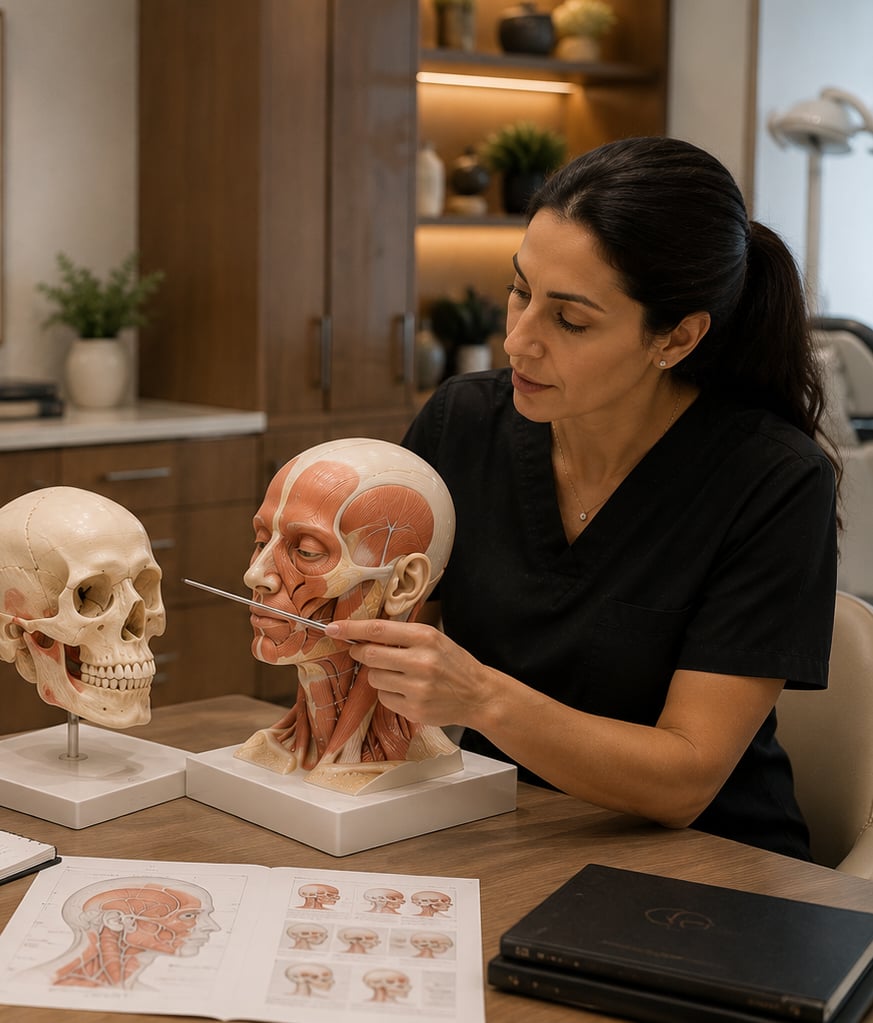
Who Can Take Botulinum Toxin A (Botox) Training at AMEQ?
This program is intended for dentists who are members of the Ordre des dentistes du Québec and are seeking structured education in botulinum toxin A within ODQ professional framework. AMEQ currently cannot accept dentists who are not ODQ members for the practical dentist training because AMEQ’s insurance does not cover complications that may arise for non-ODQ members.
Quebec Dentists New to Facial Aesthetics
The initial levels may be appropriate for dentists who have not previously completed formal botulinum toxin A education and need a structured theoretical and professional foundation.
Dentists With Previous Injectable Training
Dentists Planning a Progressive Pathway
The ODQ framework separates foundational theory, upper-face and bruxism education, later toxin progression, and filler education.
Dentists Working With Nurse Injectors
To comply with ODQ guidelines, a dentist is allowed to be the medical director of a nurse for the procedures the dentist has trained for. The dentist is responsible for assessment, diagnosis, treatment planning, mapping, dosing, documentation, orders, on-site workflow, and professional responsibility.
Understanding the Quebec Dentist Training Pathway
The ODQ guide describes progressive levels of education and clinical activity. AMEQ Academy specifically designed their training for dentists to satisfy the ODQ requirements for dentists to do injections of Botulinum toxin A and filler. Dentists remain responsible for ensuring that their chosen education corresponds to the current guide.
At AMEQ, Steps 1 and 2 are offered together in the current initial dentist registration. Step 1 provides the online theoretical component and Step 2 provides the supervised practical component. Steps 3 and 4 are available as separate registrations. Dentists who completed previous steps with another provider may register for the appropriate next step at AMEQ if they meet the applicable progression requirements.
Level 1: Theoretical Foundation
Level 1 establishes the theoretical base. At AMEQ, the Step 1 online theory provides 16 UFC and is completed independently at the dentist’s own pace. Participants retain access to the online theory for up to 6 months after completing the practical course. The theory includes botulinum toxin A foundations, facial anatomy, patient assessment, safety, documentation, complication management, and filler theory.
Level 2: Upper Face and Bruxism
Level 2 addresses upper-face treatment, bruxism, and masseter treatment through supervised practical education. At AMEQ, Step 2 provides 32 UFC of practical training and is taught directly by Dr. Angelina Guzzo. Practical training includes patient assessment, treatment planning, injection planning, supervised hands-on learning, and clinical integration.
Level 3: Later Toxin Progression
Level 4: Filler Agents
Level 4 addresses practical dermal filler injection education and is eligible for 32 UFC. To remain aligned with the ODQ pathway, filler injection is introduced practically only at Level 4. At AMEQ, filler theory is included in step 1 because it is the only opportunity to cover the theoretical foundation for filler injection and complication management.
What the Dentist Training Covers
The current AMEQ dentist registration includes Steps 1 and 2 together. The curriculum combines 16 UFC of online theory with 32 UFC of supervised practical training, covering botulinum toxin A foundations, upper-face treatment planning, bruxism, masseter treatment, patient assessment, documentation, safety, and clinical integration.
Facial Anatomy and Functional Assessment
Facial muscles, movement patterns, vascular considerations, functional relationships, and patient-specific anatomical variation.
Patient Consultation and Clinical Decision-Making
Health history, objectives, contraindications, asymmetry, treatment limitations, deferral, and referral.
Botulinum Toxin A Pharmacology
Mechanisms, onset and duration concepts, handling, storage, reconstitution principles, dosing considerations, and product information.
Upper-Face Treatment Planning
Anatomy, muscle balance, individualized assessment, conservative planning, and functional or aesthetic consequences.
Bruxism and Masseter Considerations
Detailed education in bruxism and masseter treatment, including functional assessment, masseter anatomy, patient selection, treatment planning, documentation, treatment limitations, follow-up, and safety considerations.
Clinical Photography and Records
Standardized photography, charting, lot documentation, treatment regions, doses, consent, instructions, and follow-up.
Safety and Complication Awareness
Prevention, early recognition, communication, documentation, follow-up, escalation, and referral.
Practice and Collaboration Systems
Consultation flow, clinical setup, emergency readiness, collaboration, and responsible integration into a dental environment.
How AMEQ's Botulinum Toxin A Training for Dentists Is Delivered
Online Preparation
The online component provides 16 UFC of theoretical training and is completed independently at the dentist’s own pace. Participants have access to the online theory for up to 6 months after completing the practical course.
In-Person Practical Training
The practical component provides 32 UFC of hands-on training in Montreal. It includes instructor explanation, demonstration, patient assessment, treatment planning, supervised practical learning, and clinical integration.
Direct Instruction by Dr. Guzzo
The practical course is taught directly by Dr. Angelina Guzzo and is not delegated to another instructor.
Small-Group Learning
Each cohort is limited to a maximum of 4 dentists. AMEQ normally provides 7 to 8 patients or models per cohort. Participants may assess and treat patients or models directly under supervision, depending on case flow, suitability, and clinical judgment.
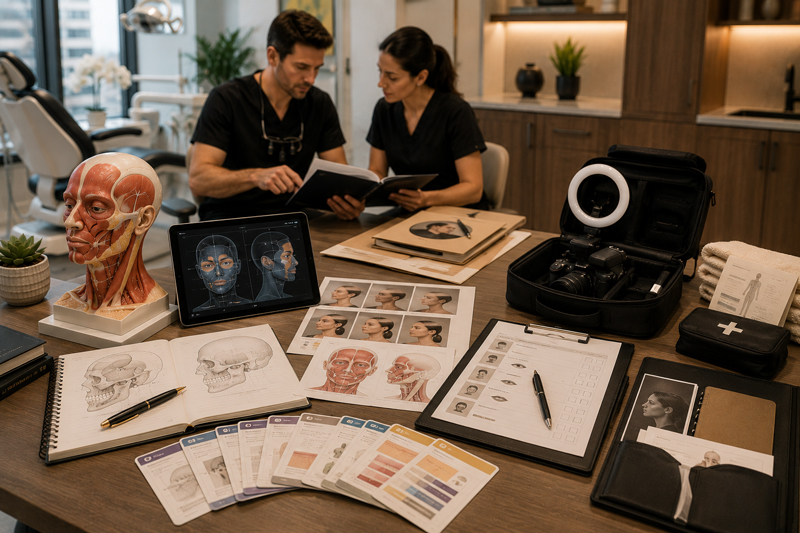
Clear Training Stages
Botulinum Toxin A and Dermal Fillers Are Separate Training Stages
Botulinum toxin A and hyaluronic acid dermal fillers are different treatment categories with different mechanisms, techniques, risks, and training requirements. Dentists should receive clear information about which levels and product categories are included in the current registration.
| Topic | Botulinum toxin A education | Hyaluronic acid dermal filler education |
|---|---|---|
| Primary mechanism | Temporarily reduces selected muscle activity | Adds or restores volume in selected tissue planes |
| Main educational focus | Muscle anatomy, function, balance, dosage, diffusion, and functional effects | Tissue planes, vascular anatomy, product selection, rheology, placement, and vascular risk |
| Quebec pathway | Introduced through Levels 1 and 2, with later toxin progression at Level 3 | Addressed at Level 4 after applicable prior levels and patient experience |
| Current AMEQ registration | Current registration includes Steps 1 and 2 together, with 16 UFC of online theory and 32 UFC of practical training. | Practical dermal filler injection training is delivered at Level 4 and is eligible for 16 UFC. |
Botox training for dentists in Quebec
Dr. Guzzo trains Quebec Dentist in Medical Aesthetics
Our Botox training for dentists program is comprehensive and personalized.

Angelina Guzzo
BSc, PhD, MDCM, FRCPC
AMEQ Educational Leadership
AMEQ Academy is founded and medically directed by Dre Angelina Guzzo, BSc, PhD, MDCM, FRCPC. She is a physician and educator involved in aesthetic medicine education for licensed healthcare professionals in Quebec.
The practical component of the dentist training is taught directly by Dr. Angelina Guzzo and is not delegated to another instructor.
The online theoretical component is completed independently by the participant through AMEQ’s online training structure, with access available for up to 6 months after the practical course is completed.
- Professional healthcare education
- Facial anatomy and clinical assessment
- Patient safety awareness
- Responsible treatment planning
- Supervised practical learning
- Quebec professional-framework context

affiliations





Basic Botulinum Toxin Botox Training for Dentists
Program Overview
The Quebec Academy of Aesthetic Medicine, AMEQ, led by Dr. Angelina Guzzo, offers a botulinum toxin A training pathway specifically for dentists who are members of the Ordre des dentistes du Québec. The current AMEQ dentist registration includes Steps 1 and 2 together, combining 16 UFC of online theoretical training with 32 UFC of supervised practical training, for a total of 48 UFC.
Step 1 provides the online theoretical foundation, including facial anatomy, botulinum toxin A concepts, filler theory, patient assessment, contraindications, consent, documentation, safety awareness, and complication management. Step 2 provides practical training focused on upper-face treatment, bruxism, masseter treatment, patient assessment, treatment planning, supervised hands-on learning, and clinical integration.
Certification & Recognition
48 UFC total
16 UFC online theory + 32 UFC practical training
Certificate of attestation
provided for completed theoretical modules and practical participation
Designed to correspond with ODQ guidance
for botulinum toxin A education
Botox Training for Dentists
What Makes AMEQ’s Training Unique
All-in-house training:
The online theory and practical training are delivered through AMEQ’s dentist training pathway.
Small group format:
Maximum 4 dentists per cohort.
Patients or models provided:
AMEQ normally provides 7 to 8 patients or models per cohort. Dentists may also bring their own model when appropriate, which can allow for more practice and follow-up.
Direct practical teaching by Dr. Guzzo:
The practical component is taught directly by Dr. Angelina Guzzo and is not delegated.
Materials included:
Course materials, practical training materials, and patient or model costs are included in the tuition.
Introductory startup support:
AMEQ provides an introductory package after completion so dentists can begin integrating toxin treatment into practice responsibly, subject to their professional obligations and practice setup.
Clear Training Stages
Course Inclusions and Post-Course Support
AMEQ’s dentist training includes the required learning materials, practical training materials, and patient or model costs for the course. After completion, AMEQ also provides practical guidance to help dentists understand where to purchase necessary materials and how to connect with product representatives.
Post-course support includes access to AMEQ for specific clinical questions, case discussion opportunities through a journal club, and practical guidance on how to introduce toxin treatment into a dental practice responsibly. Lunch-hour discussions are used to review practice integration, business model considerations, and realistic implementation steps.
Why Dentists Consider AMEQ Academy
AMEQ Academy focuses on professional aesthetic medicine education for licensed healthcare professionals. Dentists should ensure the training program they choose meets the ODQ requirements. The AMEQ Academy program for dentists was specifically designed to meet the ODQ requirements.
Dentist-Specific Curriculum
Education should connect dental knowledge with facial anatomy, upper-face planning, bruxism, documentation, safety, and Quebec requirements.
Montreal Training Location
The dentist program is presented at AMEQ Academy’s confirmed Montreal location. Current cohort information identifies any additional confirmed training location.
Progressive Professional Context
AMEQ provides the progressive framework to meet the ODQ requirements.
Assessment and Clinical Systems
The training emphasis extends beyond injection technique to consultation, treatment planning, documentation, follow-up, and risk recognition.
Questions Dentists Consider Before Registering
I Have No Previous Aesthetic Injection Experience
The current AMEQ registration includes Steps 1 and 2 together. Step 1 provides the online theoretical foundation and Step 2 provides supervised practical training in upper-face, bruxism, and masseter treatment.
I Already Completed Another Toxin Course
Dentists who completed previous steps elsewhere may register for the appropriate next step at AMEQ, provided they meet the applicable requirements for progression.
I Want Filler Training as Well
Practical dermal filler training is delivered at Level 4 and requires a separate registration. Filler theory is included in Step 1 because it provides the theoretical foundation for filler injection and complication management.
I Plan to Work With a Nurse Injector
Dentist-nurse collaboration carries examination, diagnosis, planning, mapping, dosing, verification, presence, documentation, and professional-responsibility obligations.
I Practise Outside Quebec
AMEQ currently accepts dentists who are members of the Ordre des dentistes du Québec. Dentists who are not ODQ members cannot register for the practical dentist training because AMEQ’s insurance does not cover complications that may arise for non-ODQ members.
I Need Continuing Education Recognition
The program provides 16 UFC for Step 1, 32 UFC for Step 2, 32 UFC for Step 3 and 32 UFC for Step 4. Certificates of attestation are provided for completed online theoretical modules and for practical participation where applicable.
I Need Flexible Payment Options
Current tuition, deposit, financing, and balance terms are provided through the AMEQ training team.
AMEQ
Our hands-on certification course in Botox training for Dentists, available in Montreal and St-Sauveur, covers botulinum toxin A (Botox) and hyaluronic filler techniques, patient safety, and clinical integration, giving you the tools to expand your services in compliance with Quebec regulations.
Hands-On Experience with Live Models
From your first practical day, you’ll inject real patients in a safe, supervised environment. This live model training accelerates skill development and ensures you’re ready to confidently introduce aesthetic services into your dental practice immediately after certification with our Fillers and Botox Training for Dentists.
Why Train with AMEQ in Montreal and St-Sauveur
- Quebec’s trusted training academy for healthcare professionals
- Led by Dr. Guzzo, an experienced medical aesthetics trainer
- Small-group sessions for personalized instruction
- Located in the heart of Montreal for easy access across Quebec
- Training is also offered in Saint-Sauveur for those located further north in Quebec or who want to enjoy time in a sought after vacation spot
- Post-course mentorship and business integration guidance
Career Benefits for Dentists
Adding Botulinum toxin A (Botox) and hyaluronic acid filler treatments allows you to expand your scope of practice, attract new patients, and increase profitability. Many AMEQ graduates report improved patient retention and a stronger competitive position in the dental and aesthetics market.

Basic Botulinum Toxin Botox Training for Dentists
Register for the Next Session
- Open to licensed dentists in Quebec.
- No prior injection experience is necessary.
- All prerequisite modules are included in the course package.
Spaces are limited to ensure quality instruction. Reserve your place today and take the next step in expanding your dental practice.
Pricing
$4995
which is an all-inclusive pricing for step 1 and step 2. Financing plans are available.
Training for Dentists
FAQ
Current ODQ guidance requires dentists to have treated a minimum of 20 patients with botulinum toxin A, including upper-face and bruxism treatments, before Level 3. An interval of approximately six months following Level 2 is recommended, but elapsed time alone does not establish eligibility.
Yes, for supported procedures and only when all applicable conditions are met. The dentist retains examination, diagnosis, planning, mapping, dose, verification, presence, documentation, and professional-responsibility obligations.
The guidance reviewed requires the dentist to remain physically present at the workplace where the order is carried out. This should not be presented as remote supervision.
Potentially, but the location must satisfy applicable dental-office requirements, be properly declared, and remain subject to inspection. A training certificate does not make a location compliant.
The exact online and in-person hours, days, and included levels should be confirmed with AMEQ for the current cohort.
AMEQ describes supervised practical education. Confirm the current patient or model count, treatment opportunities, group size, instructor ratio, consent process, and follow-up responsibilities.
The instructor and practical supervisor should be confirmed with AMEQ for the current cohort. Dre Angelina Guzzo is the founder and medical director of AMEQ Academy.
Those terms should be used only where supported by written evidence. Dentists select education whose content corresponds to the current guide and do not require prior ODQ approval before registration.
Confirm the exact eligible hours, reporting method, supporting documentation, and approved wording with AMEQ before registration.
Confirm the current certificate or attestation. A certificate does not independently establish authorization or competence.
Eligibility must be confirmed with AMEQ. Dentists from another jurisdiction remain responsible for verifying the rules and insurance requirements where they practise.
Related AMEQ Education for Dentists
Dentists may also explore related AMEQ education where course eligibility, prerequisites, and professional relevance have been confirmed.
PRP and Microneedling
Experienced practitioners may consider individualized observation or supervised learning after AMEQ confirms dentist eligibility and the current format.
Aesthetic Shadowing Course
Filler education is a separate later level. Confirm prerequisites, curriculum, patient-experience requirements, and registration structure.
Basic Facial Ultrasound Course
Facial ultrasound education may support anatomy visualization, vascular mapping, filler assessment, and complication evaluation. It does not replace procedure-specific training.