AMEQ Academy | Professional Education for Licensed Healthcare Professionals​

Facial Ultrasound Course for Healthcare Professionals in Montreal

Develop a structured foundation in facial ultrasound imaging for medical aesthetics. This full-day, hands-on AMEQ Academy course introduces licensed healthcare professionals to facial anatomy visualization, tissue layers, vascular mapping concepts, and ultrasound applications that can support assessment, treatment planning, and complication awareness.

Training takes place in a small group at AMEQ Academy in Montreal, with practical scanning exercises and direct educational feedback.

Full-day in-person training, 9:00 a.m. to 5:00 p.m.   |   Montreal training location   |   Minimum 3 and maximum 6 participants   |   Hands-on facial ultrasound scanning   |   Learning materials and lunch included   |   Investment: $2,500 per healthcare professional
Contact AMEQ Academy to confirm current dates, eligibility, language, instructor, and registration terms.
FOR HEALTHCARE PROFESSIONALS

Request Facial Ultrasound Training Information

Upcoming Course Dates:

For more information, please contact us.

Registration & Payment Terms
  • A non-refundable deposit of $1,000 + taxes is required at registration to reserve your spot and access the online theory.
  • The remaining balance is due 60 days before the training start date. Personalized payment plans are available on request.
  • Cancellations made 60 days or more before training: deposit retained as an administrative fee; date transfers accepted within 12 months.
  • Cancellations made less than 30 days before training: no refund, transfer, or modification will be issued.

View full Refund and Cancellation Policy →

Direct Answer

What is facial ultrasound training in medical aesthetics?

Facial ultrasound training teaches healthcare professionals how to use ultrasound imaging to recognize facial tissue layers, muscles, vascular structures, and other anatomy relevant to aesthetic procedures. In medical aesthetics, ultrasound can support patient-specific anatomy assessment, vascular mapping, treatment planning, and the evaluation of certain complications. It complements, rather than replaces, clinical assessment and anatomical knowledge.

On March 27, 2025, the Ordre des dentistes du Québec published its guide on the use of botulinum toxin A and filling agents. The guide introduced clearer expectations related to education, clinical experience, patient assessment, documentation, treatment location, and professional responsibility.

The ODQ does not provide the clinical training itself and does not require dentists to obtain prior approval before registering for a course. Each dentist remains responsible for selecting education whose content corresponds to the current guide.

On June 26, 2025, the ODQ published modifications to the guide on botulinum toxin A and filling agents. These modifications clarified progression requirements, including the patient-experience thresholds, recommended intervals between later training levels, and the conditions governing collaboration with another authorized healthcare professional.

On September 29, 2025, the ODQ published answers to frequently asked questions about botulinum toxin injections and filling agents. The FAQ clarifies that dentists do not need prior ODQ approval before registering for a course, while remaining responsible for choosing education that corresponds to the guide.

This creates an important reason for dentists to review their education and professional preparation:

  • Dentists entering the field need education aligned with the current framework.
  • Dentists with previous injectable training should verify whether their earlier curriculum covers the required content.
  • Additional or bridge education may be required when previous training does not correspond to the guide.
  • Progression to advanced levels depends on both education and clinical experience.
  • Dentists planning to collaborate with nurse injectors need sufficient knowledge to assess patients, establish diagnoses, formulate treatment plans, map injection sites, specify doses, verify the other professional’s authority and training, remain physically present at the workplace, and accept the professional responsibility associated with an order.

In November 2025, four Quebec professional orders announced a joint process to develop clearer common guidance for medical aesthetic care. This initiative was described as an ongoing guidance process, not an automatic expansion of professional practice rights.

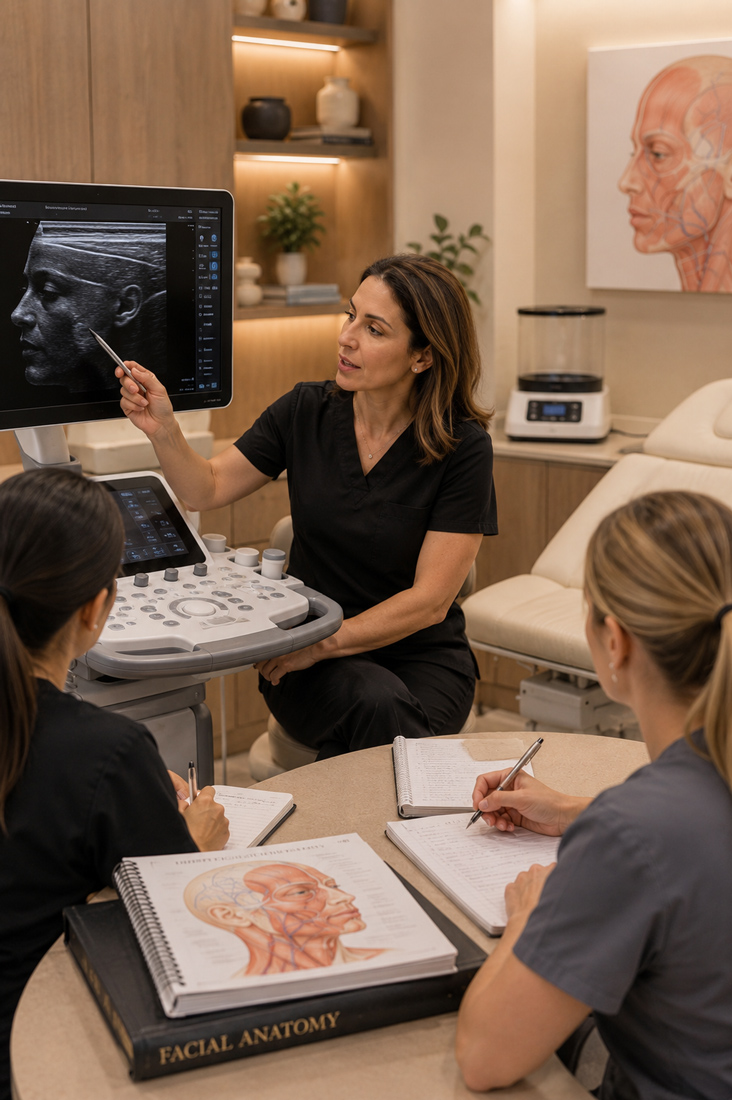
Small group of healthcare professionals learning facial ultrasound scanning
Facial Ultrasound Education

Facial Ultrasound Education for Aesthetic Practice

Facial anatomy varies from one patient to another. Surface landmarks and anatomical averages remain important, but they do not show the practitioner the exact position of every vessel, tissue plane, muscle, or previously placed product in an individual patient.

High-frequency ultrasound adds a real-time imaging layer to clinical assessment. It can help a trained practitioner visualize structures below the skin, recognize tissue planes, examine facial regions, and identify anatomy relevant to injection planning and risk awareness.

In medical aesthetics, facial ultrasound may be incorporated into several clinical contexts:

Ultrasound does not eliminate procedural risk, replace clinical judgement, or guarantee a treatment outcome. Its value depends on the practitioner’s training, image-acquisition skill, interpretation, device quality, and responsible application within the practitioner’s professional framework.
POCUS stands for point-of-care ultrasound. It refers broadly to ultrasound used by a healthcare professional at or near the point of patient care. Facial ultrasound in medical aesthetics may be considered a focused POCUS application, but this AMEQ course is not a general diagnostic sonography program and does not provide a broad qualification in medical ultrasound.
Facial Ultrasound Education for Aesthetic Practice

Why Learn Facial Ultrasound for Injection Safety?

Aesthetic procedures take place in anatomically complex regions. Facial vessels can vary in course, depth, and relationship to surrounding tissue. The lips, nose, temples, forehead, midface, jawline, and chin each present different anatomical considerations. Facial ultrasound education helps practitioners connect textbook anatomy with live, patient-specific imaging. During training, participants learn to orient the probe, recognize structures, and relate the ultrasound image to the facial region being examined.

Patient-specific anatomy

Ultrasound can display anatomy as it appears in the person being scanned. This supports a more individualized understanding than relying only on average anatomical diagrams.

Vascular awareness

Ultrasound imaging can help identify facial arteries and veins relevant to aesthetic treatment planning. The ability to recognize vascular structures depends on image quality, probe technique, equipment settings, and practitioner training.

Tissue-layer recognition

Facial ultrasound can help distinguish layers and structures such as skin, subcutaneous tissue, fascia, muscle, fat compartments, periosteum, and selected glandular structures.

Assessment and planning

Imaging may support decisions about whether a region requires further evaluation, whether previous filler is present, and whether a planned approach should be reconsidered. Ultrasound findings must be integrated with history, examination, consent, and professional judgement.

Complication awareness

The course introduces how ultrasound may be used in the assessment and treatment context of selected aesthetic complications. This is an educational introduction, not a guarantee that a participant will be able to independently diagnose or manage every complication after one course.
Curriculum

What You Will Learn in the Facial Ultrasound Course

The curriculum follows a region-by-region approach so participants can relate ultrasound images to clinically relevant facial anatomy.

Ultrasound handling and image acquisition

Participants are introduced to practical probe handling and the basic steps used to obtain facial ultrasound images. The objective is to build familiarity with orientation, contact, pressure, image position, and recognition of common structures.

Jawline, masseter, parotid, and facial vessels

The jawline module focuses on imaging the masseter region, parotid area, facial artery, and facial vein. Participants learn how these structures may appear and how their relationships can vary.

Midface and the five facial layers

The midface module examines the zygomatic region and the layered anatomy of the face. Participants review the continuity of the superficial musculoaponeurotic system, commonly called the SMAS, and relate ultrasound findings to tissue depth and treatment planning. The session also introduces anatomy around the pyriform fossa, orbicularis oculi, tear trough, and sub-orbicularis oculi fat, commonly called the SOOF.

Temple anatomy and the nine layers

The temple requires careful anatomical understanding because of its layered structure and vascular relationships. Participants learn to image the region, recognize the nine-layer concept, and discuss tissue planes and danger zones relevant to aesthetic procedures.

Chin and lower lip

Participants examine the chin, associated muscles, and vascular structures, including the ascending mental arteries. The objective is to connect ultrasound anatomy with planning and risk awareness in the lower face.

Upper and lower lip

The lip module focuses on imaging the upper and lower lips and identifying labial vascular structures. Participants review how vessel position and depth can vary.

Nose and nasal vessels

Participants are introduced to ultrasound imaging of the nose and relevant vascular anatomy. The module emphasizes careful image interpretation and the limitations of a short foundational course.

Forehead and perforating vessels

The forehead module covers tissue layers, associated vessels, and perforating branches relevant to anatomy education and treatment planning.

Ultrasound in complication assessment

The final clinical module introduces the role ultrasound may have when assessing selected concerns after aesthetic procedures. Participants discuss how imaging can contribute to a broader clinical evaluation and when escalation, referral, or additional expertise may be required.
Facial Ultrasound Education

Hands-On Facial Ultrasound Training in a Small Group

Facial ultrasound is a visual and practical skill. Reading about image orientation is not the same as learning how probe position, pressure, angle, device settings, and patient anatomy affect the image in real time. AMEQ Academy’s course is presented as a hands-on practical program with a minimum of three and a maximum of six participants. The small-group structure is intended to provide time for scanning practice, observation, discussion, and direct educational feedback.

What the practical component includes

What the course does not guarantee

A one-day course does not guarantee independent competence, remove the need for further supervised practice, or authorize a participant to perform procedures outside their professional scope. Participants remain responsible for device-specific training, professional requirements, insurance, workplace policies, and ongoing skill development.
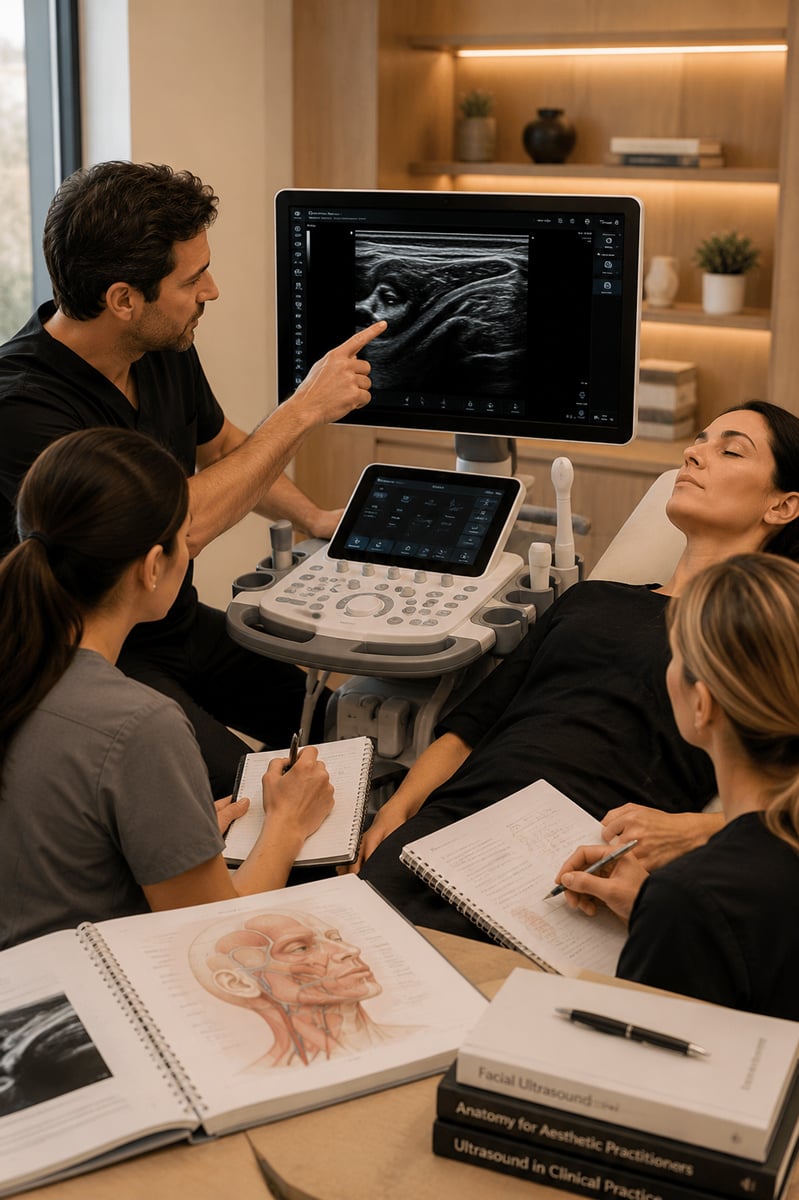
Practitioner performing non-invasive ultrasound scanning of the lower face

Facial Ultrasound Education

Facial Ultrasound and Landmark-Based Anatomy Education

Facial ultrasound does not replace anatomical study or clinical assessment. It adds a patient-specific imaging method that may complement those foundations.
Consideration Landmark and anatomy-based assessment Ultrasound-supported assessment
Main information source Surface landmarks, palpation, history, examination, and anatomical knowledge Real-time imaging used alongside history, examination, and anatomical knowledge
Patient-specific internal anatomy Inferred from examination and known anatomical patterns Selected structures may be visualized in the person being scanned
Vascular mapping Based mainly on known vessel pathways and clinical assessment Vascular structures may be identified when image quality, equipment, and practitioner skill are appropriate
Tissue layers Estimated from anatomy, palpation, and technique Layers may be viewed and compared in real time
Previous filler Based on history, palpation, records, and examination Some previously placed filler may be visualized and assessed
Training role Essential foundation for every aesthetic practitioner Additional imaging skill that requires specific education and practice
Limitation Does not show exact internal anatomy in real time Operator-dependent and does not eliminate clinical uncertainty or procedural risk
AMEQ Academy

Facial Ultrasound Course Agenda

The current course agenda runs from 9:00 a.m. to 5:00 p.m. AMEQ Academy may adjust the sequence when required for teaching, equipment, or participant needs.

9:00 a.m. to 10:00 a.m.

Introduction to Ultrasound

  • Equipment orientation
  • Image orientation and basic terminology
  • Probe handling concepts
  • Practical limitations of facial ultrasound

10:00 a.m. to 10:45 a.m.

Jawline, Masseter, Parotid, and Vessels

  • Masseter imaging
  • Parotid anatomy
  • Facial artery and vein identification
  • Regional anatomy discussion

10:45 a.m. to 11:15 a.m.

Midface and Periorbital Anatomy

  • Zygomatic region
  • Pyriform fossa
  • Facial layers and danger-zone awareness
  • Orbicularis oculi
  • Tear trough and SOOF anatomy

11:15 a.m. to 11:30 a.m.

Break

11:30 a.m. to 12:15 p.m.

Temple Anatomy

  • Nine-layer concept
  • Tissue-plane recognition
  • Vascular and anatomical considerations
  • Danger-zone discussion

12:15 p.m. to 1:00 p.m.

Lunch

Healthcare professionals sharing a lunch break during facial ultrasound training at AMEQ Academy in Montreal

1:00 p.m. to 1:45 p.m.

Chin and Lower Lip

  • Chin muscles
  • Lower-face anatomy
  • Ascending mental arteries
  • Regional planning considerations

1:45 p.m. to 2:15 p.m.

Upper Lip

  • Lip layers
  • Labial vascular anatomy
  • Image orientation

2:15 p.m. to 2:30 p.m.

Break

2:30 p.m. to 3:00 p.m.

Nose

  • Nasal anatomy
  • Selected vascular structures
  • Image interpretation limitations

3:00 p.m. to 3:30 p.m.

Forehead

  • Forehead layers
  • Vessels and perforators
  • Clinical anatomy discussion

3:30 p.m. to 4:30 p.m.

Introduction to Ultrasound in Complication Assessment and Treatment Context

  • Selected post-procedure concerns
  • Role of ultrasound within a broader assessment
  • Limits of foundational training
  • Escalation and referral awareness

4:30 p.m. to 5:00 p.m.

Review and Quiz

  • Knowledge review
  • Image-recognition questions
  • Final discussion
  • Next learning steps
Audience

Who Should Attend This Facial Ultrasound Training?

Physicians

Physicians working in or entering medical aesthetics may use the course to strengthen their understanding of live facial anatomy and the practical role of ultrasound in assessment, planning, and complication awareness. Physicians remain responsible for meeting the requirements that apply when adding or modifying an area of medical practice in Quebec.

Nurses and nurse practitioners

Licensed nurses and nurse practitioners with a foundation in medical aesthetics may take the course as professional development. Completing the course does not independently grant the right to practise medico-aesthetic procedures in Quebec. Where applicable, nursing practice must include an individual patient evaluation and an order or prescription from an authorized professional, along with a detailed treatment plan appropriate to the patient. Participants must also confirm supervision, insurance, workplace, documentation, and follow-up requirements.

Dentists

Dentists may benefit from facial ultrasound education where it is relevant to their authorized professional activities and clinical setting. Each dentist remains responsible for confirming the requirements and limits established by the Ordre des dentistes du Québec and any other applicable standards.

Other licensed healthcare professionals

Eligibility for other professionals must be confirmed with AMEQ Academy and the participant’s regulatory body. Registration in a course does not establish professional authorization.

Experience level

This is a foundational facial ultrasound course, but it assumes that participants already understand healthcare practice and have a foundation in medical aesthetics or aesthetic injections. It is not intended for the general public or unlicensed beauty practitioners.
Angelina Guzzo, founder and medical director of AMEQ Academy
Facial Ultrasound Education​

Physician-Led Medical Aesthetics Education at AMEQ Academy

AMEQ Academy provides structured aesthetic medicine education for licensed healthcare professionals in Quebec. The Academy’s training pages are designed to connect theory, anatomy, professional responsibilities, supervised learning, and practical clinical context.

Dr. Angelina Guzzo, BSc, PhD, MDCM, FRCPC, is the founder and medical director of AMEQ Academy. Her visible role on this page should reinforce AMEQ’s physician-led educational standards and commitment to responsible professional development.

Facial Ultrasound Training for Healthcare Professionals

Facial Ultrasound Training Within Quebec’s Professional Framework

AMEQ Academy provides education and professional development. It does not issue a professional licence, expand a participant’s legal scope of practice, authorize independent aesthetic practice, or replace the requirements of a professional order.

Healthcare professionals are responsible for confirming:

For nurses in Quebec, current OIIQ guidance states that an aesthetic treatment administered by a nurse must be supported by an individual prescription and a detailed treatment plan specific to the patient. If the nurse’s evaluation identifies a condition that makes the prescribed care inappropriate, the patient must be referred back to the authorized prescriber.

This page is educational and does not provide legal advice. Participants should review current guidance from the CMQ, OIIQ, ODQ, or their applicable professional body

Healthcare professional reviewing facial ultrasound and anatomy materials within Quebec’s professional practice framework

Facial Ultrasound Training for Healthcare Professionals Across Quebec

The course is held at AMEQ Academy’s Montreal location. Healthcare professionals may travel to Montreal from Laval, Longueuil, Brossard, the West Island, Terrebonne, Repentigny, Saint-Jérôme, Saint-Sauveur, Quebec City, Lévis, Gatineau, Sherbrooke, Trois-Rivières, Drummondville, Granby, Saguenay, Rimouski, and other Quebec communities.

Healthcare professionals from elsewhere in Canada may also contact AMEQ Academy to discuss eligibility, course dates, language, travel planning, and whether the curriculum fits their professional background.

These city references describe the audience the Montreal course may serve. They do not represent additional AMEQ course locations.

Course detail

Facial Ultrasound Training at a Glance

Course:

Facial Ultrasound Training for Injection Safety

Audience:

Licensed healthcare professionals with a foundation in medical aesthetics or aesthetic injections

Format:

Full-day, in-person, hands-on training

Schedule:

9:00 a.m. to 5:00 p.m.

Group size:

Minimum 3, maximum 6 participants

Location:

600 Sherbrooke Street East, Suite 101, Montreal, QC H2L 1K1

Investment:

$2,500 per healthcare professional

Included:

Learning materials and lunch

Compliant dental practice environment with emergency equipment and confidential records

Facial Ultrasound Training

Registration Information

Contact AMEQ Academy to confirm the next available facial ultrasound training date, eligibility, assigned instructor, language, equipment, and current registration terms.

The current page contains conflicting balance deadlines. Until AMEQ confirms one policy, use this public wording:

A deposit is required to reserve a confirmed training place. Contact AMEQ Academy for the current balance deadline, payment options, cancellation terms, and tax information. Review the Refund and Cancellation Policy before registering.

AMEQ Training Courses

Continue Your AMEQ Training Pathway

A foundational pathway for licensed nurses and nurse practitioners beginning aesthetic medicine education in Quebec.
A more intensive nurse pathway with online theory, supervised practical education, and 20+ supervised live-model learning opportunities.
Professional education in PRP preparation, microneedling, skin applications, and hair-restoration treatment context.
A foundational pathway for licensed nurses and nurse practitioners beginning aesthetic medicine education in Quebec.
Private one-on-one mentorship for experienced injectors who want direct supervised feedback on selected techniques.
Learn about AMEQ Academy’s physician-led approach to professional education for healthcare professionals.

Facial Ultrasound Training

Frequently Asked Questions About Facial Ultrasound Training

Facial ultrasound training introduces licensed healthcare professionals to ultrasound imaging of facial anatomy. It may cover image acquisition, tissue layers, muscles, glands, vessels, vascular mapping concepts, treatment-planning applications, and selected complication-assessment contexts. It is focused professional education and is not a general diagnostic sonography qualification.

The course is intended for licensed healthcare professionals, including physicians, nurses, nurse practitioners, dentists, and other eligible professionals with a foundation in medical aesthetics or aesthetic injections. AMEQ should confirm each applicant’s fit before registration.

The current page indicates that participants should have a foundation in medical aesthetics. Contact AMEQ to discuss whether your education and practical background are appropriate for the course. Professionals who are completely new to aesthetic medicine may need foundational training first.

No. This is a focused facial ultrasound course for healthcare professionals in medical aesthetics. It does not provide broad diagnostic sonography education, replace regulated ultrasound qualifications, or authorize diagnostic activities outside a participant’s professional scope.

The current curriculum includes the jawline, masseter, parotid region, midface, zygomatic region, temple, chin, upper and lower lips, nose, and forehead. It also addresses selected facial vessels, tissue layers, and structures relevant to aesthetic planning.

The objectives include identifying the facial artery and vein, labial arteries, ascending mental arteries, nasal vessels, and forehead vessels. Confirm the exact Doppler equipment and scanning modes used in the current cohort before registration.

Yes. The current page presents the course as hands-on practical training. Participants practise facial scanning and image recognition in a small-group educational setting.

The current course page states a minimum of three and a maximum of six participants. Confirm the class status and practical format with AMEQ for the date you are considering.

The current agenda runs from 9:00 a.m. to 5:00 p.m. and includes teaching sessions, scanning activities, breaks, lunch, review, and a quiz.

The current public investment is $2,500 per healthcare professional. Confirm whether taxes are additional and verify current payment terms before registering.
The current page lists comprehensive learning materials, hands-on practical sessions, and lunch. Confirm whether any online theory, certificate, equipment access, or post-course support is included.
The published location is AMEQ Academy, 600 Sherbrooke Street East, Suite 101, Montreal, Quebec H2L 1K1.
The AMEQ website is available in English and French, but the language offered for each ultrasound cohort requires confirmation. Ask AMEQ about the language of instruction before registering.
The current ultrasound page does not provide sufficiently clear, conflict-free certificate information. Contact AMEQ to confirm whether an AMEQ certificate of completion is issued for this course. Do not interpret a course certificate as a professional licence or regulatory authorization.
Not automatically. Facial ultrasound is operator-dependent and requires continued practice, appropriate equipment, image-interpretation skill, professional authorization, and responsible integration into clinical workflows. One course does not guarantee competence or independent practice rights.
No imaging method eliminates procedural risk. Facial ultrasound can support anatomy visualization, vascular mapping, planning, assessment, and selected image-guided procedures when used by an appropriately trained and authorized practitioner. Clinical evaluation, anatomy knowledge, consent, technique, follow-up, and escalation planning remain essential.
The course provides professional education only. Every participant must practise within their profession’s current Quebec framework. For nurses, this may include an individual patient evaluation and an order or prescription from an authorized professional, along with a patient-specific treatment plan and other applicable requirements.
The current ultrasound course details identify the Montreal location. Do not assume that it is offered in Saint-Sauveur or other cities. Contact AMEQ for any confirmed future location options.
AMEQ Academy - Facial Ultrasound Course for Healthcare Professionals

Facial Ultrasound Training Summary

Request Information About Facial Ultrasound Training in Montreal

Facial ultrasound can add a patient-specific imaging perspective to anatomy education, vascular awareness, treatment planning, and complication assessment. AMEQ Academy’s small-group course gives licensed healthcare professionals a structured introduction to these applications through a full day of practical facial scanning and discussion.

Contact AMEQ Academy to confirm your eligibility and receive the current course date, instructor, language, equipment, and registration details. 

Professional responsibility note: Training does not independently grant practice rights. Participants remain responsible for their scope, licence, insurance, supervision, patient evaluation, prescription or order requirements, device training, and all applicable professional obligations.

Registration Form

  1. To secure your place in the program, a deposit of $1000 is required. This deposit grants you access to the online courses and becomes non-refundable once the theoretical training has begun.
  2. The remaining balance will be due three weeks prior to the in-person practical component. Please contact us for more information.
Beautiful middle aged woman getting hair treatment at beauty salon
Special for Models

50% Off

Pay only $300 (Value over $600)
All models receive premium treatment which includes follow ups with our professional team.

New AMEQ Location!

DOCTORS, NURSES & DENTISTS on the North Shore, get trained in injectables at our brand new location in Saint-Sauveur.

August 3 and 4
2-day intensive training
Limited spots, reserve yours now!