



Facial Ultrasound Course for Healthcare Professionals in Montreal
Develop a structured foundation in facial ultrasound imaging for medical aesthetics. This full-day, hands-on AMEQ Academy course introduces licensed healthcare professionals to facial anatomy visualization, tissue layers, vascular mapping concepts, and ultrasound applications that can support assessment, treatment planning, and complication awareness.
Training takes place in a small group at AMEQ Academy in Montreal, with practical scanning exercises and direct educational feedback.
FOR HEALTHCARE PROFESSIONALS
Request Facial Ultrasound Training Information
Upcoming Course Dates:
For more information, please contact us.
Registration & Payment Terms
- A non-refundable deposit of $1,000 + taxes is required at registration to reserve your spot and access the online theory.
- The remaining balance is due 60 days before the training start date. Personalized payment plans are available on request.
- Cancellations made 60 days or more before training: deposit retained as an administrative fee; date transfers accepted within 12 months.
- Cancellations made less than 30 days before training: no refund, transfer, or modification will be issued.
What is facial ultrasound training in medical aesthetics?
Who can take AMEQ Academy’s facial ultrasound course?
The course is designed for licensed healthcare professionals, including physicians, nurses, nurse practitioners, dentists, and other eligible practitioners with a foundation in medical aesthetics or aesthetic injections. Participation in training does not expand a professional scope of practice or independently authorize the use of ultrasound or aesthetic procedures.
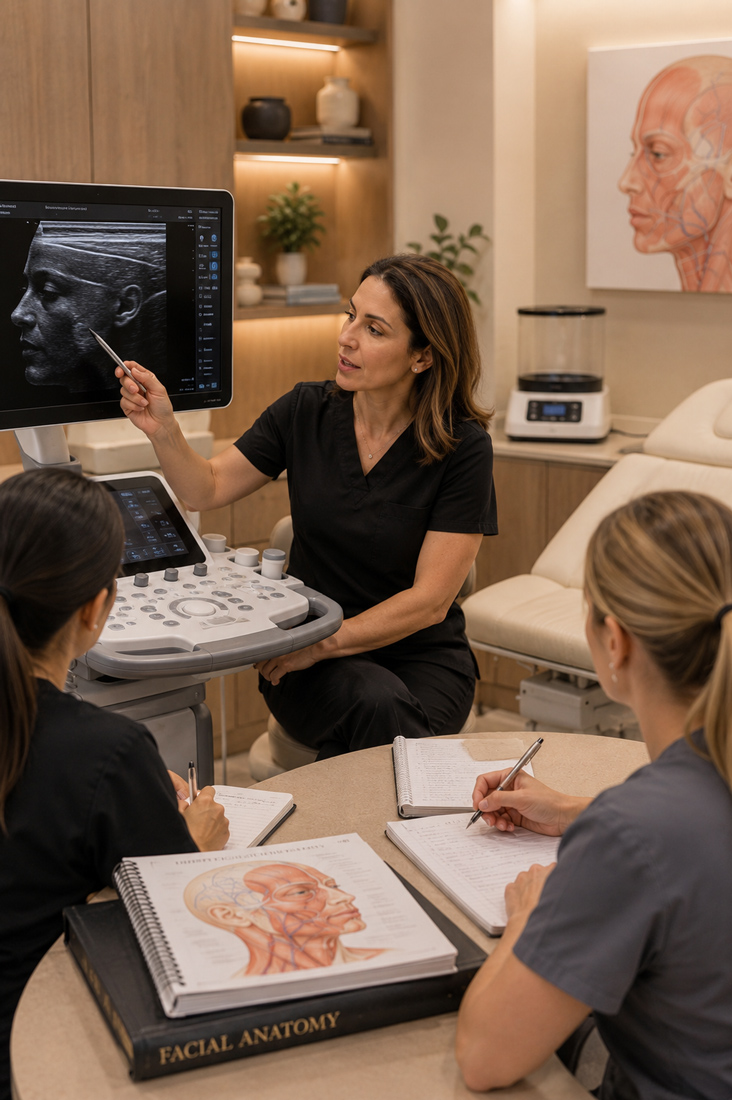
Facial Ultrasound Education for Aesthetic Practice
Facial anatomy varies from one patient to another. Surface landmarks and anatomical averages remain important, but they do not show the practitioner the exact position of every vessel, tissue plane, muscle, or previously placed product in an individual patient.
High-frequency ultrasound adds a real-time imaging layer to clinical assessment. It can help a trained practitioner visualize structures below the skin, recognize tissue planes, examine facial regions, and identify anatomy relevant to injection planning and risk awareness.
In medical aesthetics, facial ultrasound may be incorporated into several clinical contexts:
- Pre-treatment anatomical assessment
- Facial vascular mapping
- Tissue-plane and depth assessment
- Evaluation of previously placed filler
- Support for treatment planning in anatomically complex regions
- Assessment of selected post-treatment concerns or suspected complications
- Image-guided procedures when the practitioner has appropriate training, authorization, and equipment
Why Learn Facial Ultrasound for Injection Safety?
Patient-specific anatomy
Ultrasound can display anatomy as it appears in the person being scanned. This supports a more individualized understanding than relying only on average anatomical diagrams.
Vascular awareness
Tissue-layer recognition
Assessment and planning
Complication awareness
What You Will Learn in the Facial Ultrasound Course
Ultrasound handling and image acquisition
Jawline, masseter, parotid, and facial vessels
Midface and the five facial layers
Temple anatomy and the nine layers
Chin and lower lip
Upper and lower lip
Nose and nasal vessels
Participants are introduced to ultrasound imaging of the nose and relevant vascular anatomy. The module emphasizes careful image interpretation and the limitations of a short foundational course.
Forehead and perforating vessels
Ultrasound in complication assessment
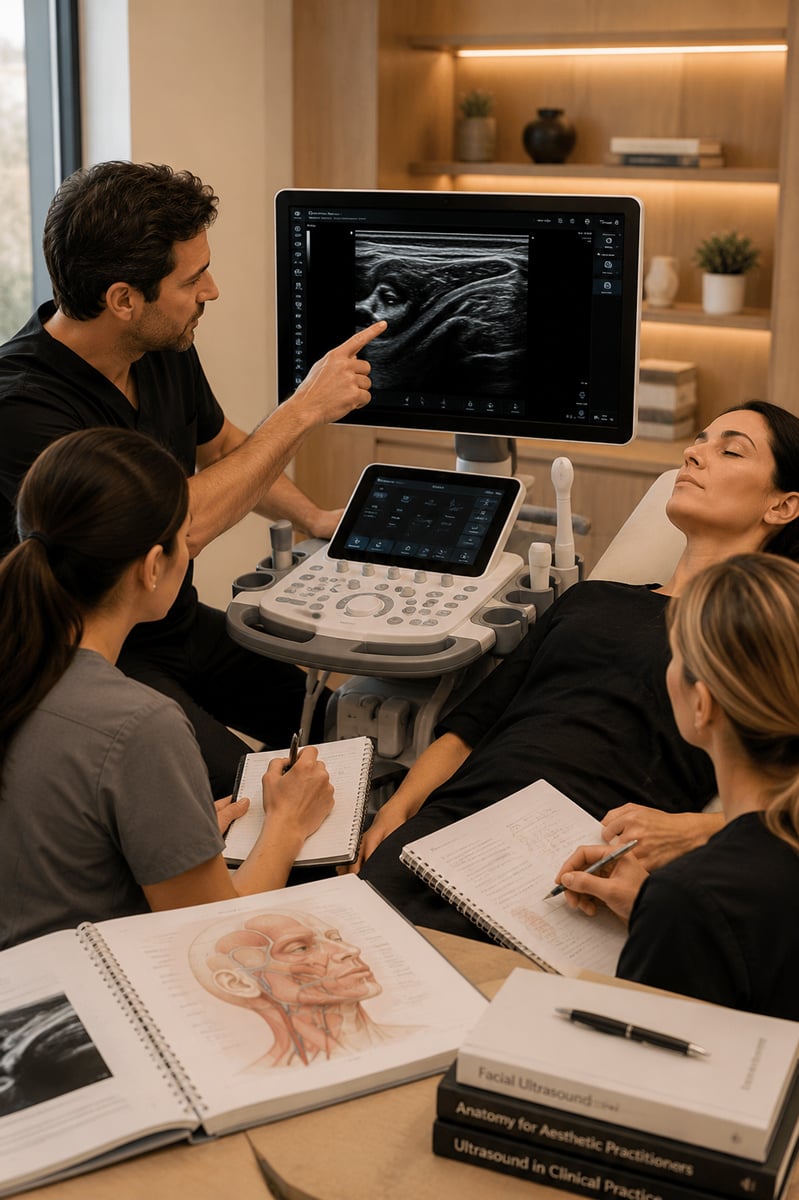
Hands-On Facial Ultrasound Training in a Small Group
Facial ultrasound is a visual and practical skill. Reading about image orientation is not the same as learning how probe position, pressure, angle, device settings, and patient anatomy affect the image in real time.
AMEQ Academy’s course is presented as a hands-on practical program with a maximum of 4 participants per group. The small-group structure is intended to provide time for scanning practice, observation, discussion, and direct educational feedback.
What the practical component includes
- Handling an ultrasound probe in facial regions
- Obtaining and orienting facial images
- Identifying selected muscles, glands, tissue layers, and vessels
- Comparing anatomy across different facial regions
- Discussing vascular mapping and risk awareness
- Reviewing the role and limitations of ultrasound in aesthetic practice
- Relating imaging findings to consultation and treatment-planning concepts
Facial Ultrasound Education
Facial Ultrasound and Landmark-Based Anatomy Education
| Consideration | Landmark and anatomy-based assessment | Ultrasound-supported assessment |
|---|---|---|
| Main information source | Surface landmarks, palpation, history, examination, and anatomical knowledge | Real-time imaging used alongside history, examination, and anatomical knowledge |
| Patient-specific internal anatomy | Inferred from examination and known anatomical patterns | Selected structures may be visualized in the person being scanned |
| Vascular mapping | Based mainly on known vessel pathways and clinical assessment | Vascular structures may be identified when image quality, equipment, and practitioner skill are appropriate |
| Tissue layers | Estimated from anatomy, palpation, and technique | Layers may be viewed and compared in real time |
| Previous filler | Based on history, palpation, records, and examination | Some previously placed filler may be visualized and assessed |
| Training role | Essential foundation for every aesthetic practitioner | Additional imaging skill that requires specific education and practice |
| Limitation | Does not show exact internal anatomy in real time | Operator-dependent and does not eliminate clinical uncertainty or procedural risk |
Facial Ultrasound Course Agenda
9:00 a.m. to 10:00 a.m.
Introduction to Ultrasound
- Equipment orientation
- Image orientation and basic terminology
- Probe handling concepts
- Practical limitations of facial ultrasound
10:00 a.m. to 10:45 a.m.
Jawline, Masseter, Parotid, and Vessels
- Masseter imaging
- Parotid anatomy
- Facial artery and vein identification
- Regional anatomy discussion
10:45 a.m. to 11:15 a.m.
Midface and Periorbital Anatomy
- Zygomatic region
- Pyriform fossa
- Facial layers and danger-zone awareness
- Orbicularis oculi
- Tear trough and SOOF anatomy
11:15 a.m. to 11:30 a.m.
Break
11:30 a.m. to 12:15 p.m.
Temple Anatomy
- Nine-layer concept
- Tissue-plane recognition
- Vascular and anatomical considerations
- Danger-zone discussion
12:15 p.m. to 1:00 p.m.
Lunch

1:00 p.m. to 1:45 p.m.
Chin and Lower Lip
- Chin muscles
- Lower-face anatomy
- Ascending mental arteries
- Regional planning considerations
1:45 p.m. to 2:15 p.m.
Upper Lip
- Lip layers
- Labial vascular anatomy
- Image orientation
2:15 p.m. to 2:30 p.m.
Break
2:30 p.m. to 3:00 p.m.
Nose
- Nasal anatomy
- Selected vascular structures
- Image interpretation limitations
3:00 p.m. to 3:30 p.m.
Forehead
- Forehead layers
- Vessels and perforators
- Clinical anatomy discussion
3:30 p.m. to 4:30 p.m.
Introduction to Ultrasound in Complication Assessment and Treatment Context
- Selected post-procedure concerns
- Role of ultrasound within a broader assessment
- Limits of foundational training
- Escalation and referral awareness
4:30 p.m. to 5:00 p.m.
Review and Quiz
- Knowledge review
- Image-recognition questions
- Final discussion
- Next learning steps
Who Should Attend This Facial Ultrasound Training?
Physicians
Dentists
Nurses and nurse practitioners
Experience level

Physician-Led Medical Aesthetics Education at AMEQ Academy
AMEQ Academy provides structured aesthetic medical education for licensed healthcare professionals in Quebec. The Academy’s training programs are designed to connect theory, anatomy, professional responsibilities, supervised learning, and practical clinical context.
Dr. Angelina Guzzo, BSc, PhD, MDCM, FRCPC, is the founder and medical director of AMEQ Academy.
Facial Ultrasound Training for Healthcare Professionals Across Quebec
The course is held at AMEQ Academy’s Montreal location. Healthcare professionals may travel to Montreal from Saint-Sauveur, Longueuil, Brossard, the West Island, Terrebonne, Repentigny, Saint-Jérôme, Saint-Sauveur, Quebec City, Lévis, Gatineau, Sherbrooke, Trois-Rivières, Drummondville, Granby, Saguenay, Rimouski, and other Quebec communities.
Healthcare professionals from elsewhere in Canada may also contact AMEQ Academy to discuss eligibility, course dates, language, travel planning, and whether the curriculum fits their professional background.
Course detail
Facial Ultrasound Training at a Glance
Course:
Facial Ultrasound Training for Injection Safety
Audience:
Licensed healthcare professionals with a foundation in medical aesthetics or aesthetic injections
Format:
Full-day, in-person, hands-on training
Schedule:
9:00 a.m. to 5:00 p.m.
Group size:
2-4 participants per group
Location:
600 Sherbrooke Street East, Suite 101, Montreal, QC H2L 1K1
Investment:
Group pricing is available. Contact AMEQ directly to get further details.
Included:
Learning materials and lunch

Facial Ultrasound Training
Registration Information
Contact AMEQ Academy to confirm the next available facial ultrasound training date, eligibility, assigned instructor, language, equipment, and current registration terms.
- Cost: $2,500 per healthcare professional
- Deposit required: $1,000
- Email: education@cliniqueag.ca
- Phone: (514) 574-4636
Continue Your AMEQ Training Pathway
Facial Ultrasound Training
Frequently Asked Questions About Facial Ultrasound Training
Facial ultrasound training introduces licensed healthcare professionals to ultrasound imaging of facial anatomy. It covers image acquisition, tissue layers, muscles, glands, vessels, vascular mapping concepts, treatment-planning applications, and selected complication-assessment contexts. It is focused professional education and is not a general diagnostic sonography qualification.
The course is intended for licensed healthcare professionals, including physicians, nurses, nurse practitioners, dentists, and other eligible professionals with a foundation in medical aesthetics or aesthetic injections.
No. This is a focused facial ultrasound course for healthcare professionals in medical aesthetics. It does not provide broad diagnostic sonography education, replace regulated ultrasound qualifications, or authorize diagnostic activities outside a participant’s professional scope.
The current curriculum includes the jawline, masseter, parotid region, midface, zygomatic region, temple, chin, upper and lower lips, nose, and forehead. It also addresses selected facial vessels, tissue layers, and structures relevant to aesthetic planning.
The objectives include identifying the facial artery and vein, labial arteries, ascending mental arteries, nasal vessels, and forehead vessels.
Yes. Participants practise facial scanning and image recognition in a small-group educational setting.
The current agenda runs from 9:00 a.m. to 5:00 p.m. and includes teaching sessions, scanning activities, breaks, lunch, review, and a quiz.
The published location is AMEQ Academy, 600 Sherbrooke Street East, Suite 101, Montreal, Quebec H2L 1K1.
The AMEQ website is available in English and French.
Course completion does not by itself authorize a professional to add a procedure to practice. Verify the current requirements of your professional order, liability insurer and clinical setting before providing a new service.
Facial Ultrasound Training Summary
- AMEQ Academy course for licensed healthcare professionals
- Primary topic: facial ultrasound in medical aesthetics
- Main location: Montreal, Quebec
- Full-day schedule from 9:00 a.m. to 5:00 p.m.
- Small group with minimum 2 and maximum of 4 partipants per group
- Hands-on scanning and facial image-acquisition practice
- Regional anatomy of the jawline, midface, temple, lips, chin, nose, and forehead
- Facial vessels, tissue layers, and vascular mapping concepts
- Introduction to ultrasound in complication assessment and treatment context
- Cost: $2500 per healthcare professional. Group pricing available. Contact AMEQ directly for more details.
- Online theoretical training, practical session and lunch are included.
Request Information About Facial Ultrasound Training in Montreal
Facial ultrasound can add a patient-specific imaging perspective to anatomy education, vascular awareness, treatment planning, and complication assessment. AMEQ Academy’s small-group course gives licensed healthcare professionals a structured introduction to these applications through a full day of practical facial scanning and discussion.
Contact AMEQ Academy to confirm your eligibility and receive the current course date, instructor, language, equipment, and registration details.
- (514) 574-4636
- education@cliniqueag.ca
- 600 Sherbrooke st. East, suite 101. Montreal. QC H2L 1K1
Professional responsibility note: Training does not independently grant practice rights. Participants remain responsible for their scope, licence, insurance, supervision, patient evaluation, prescription or order requirements, device training, and all applicable professional obligations.